LinkedIn is no longer just a platform for job searches and professional networking. For businesses, founders, consultants, agencies, and B2B marketers, it can become a powerful channel for attracting prospects, building trust, generating leads, and converting them into paying customers.
However, simply posting content or connecting with hundreds of people does not automatically generate business. A successful LinkedIn strategy requires a clear marketing funnel that guides people through different stages—from discovering your profile to eventually becoming a customer.
In this article, we explore how the LinkedIn marketing funnel works and how businesses can use each stage to turn attention into revenue.
What Is a LinkedIn Marketing Funnel?
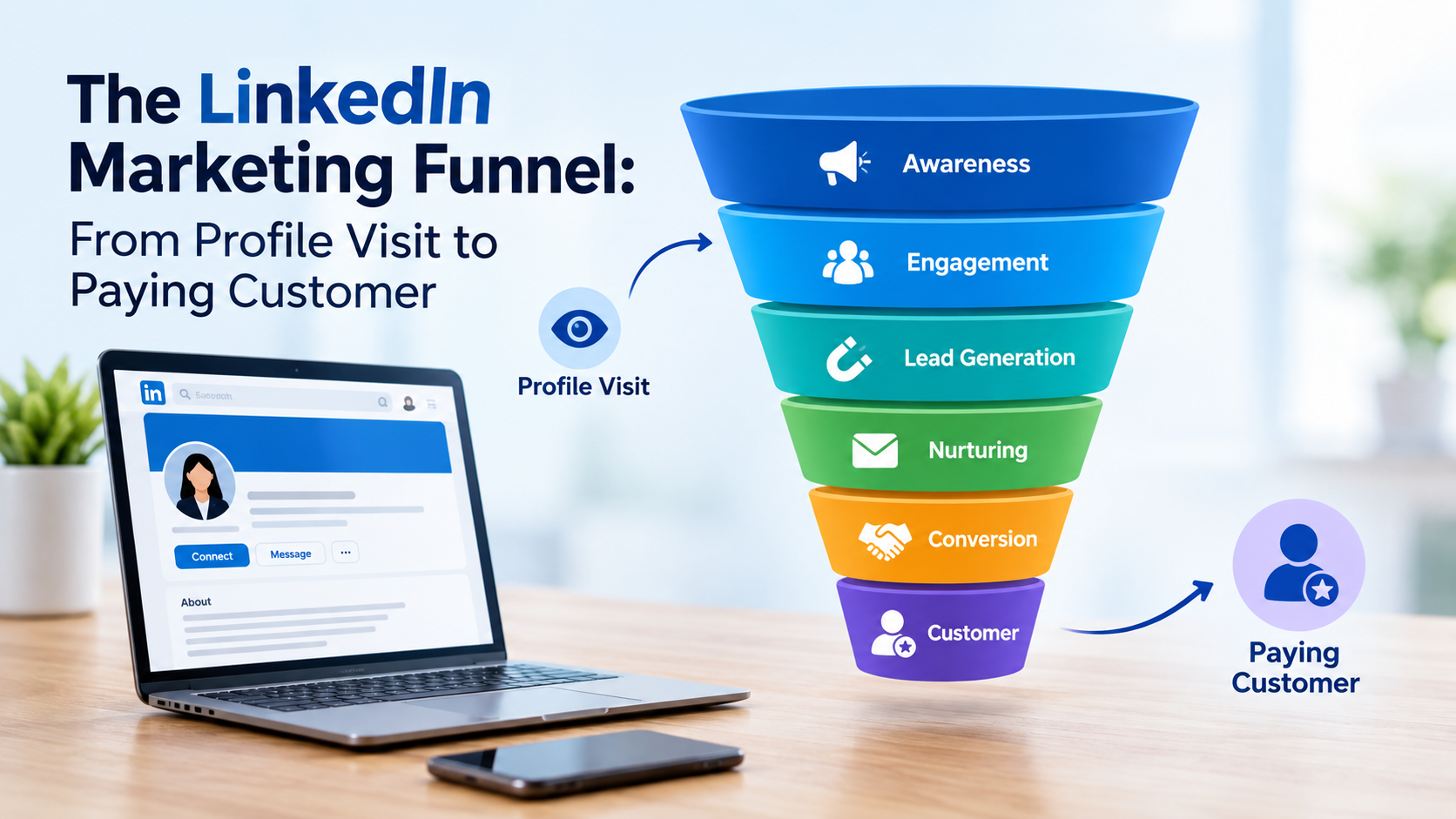
A LinkedIn marketing funnel is the journey a potential customer takes from their first interaction with your LinkedIn presence to becoming a paying customer.
A typical funnel looks like this:
Profile Visit → Awareness → Engagement → Lead Generation → Nurturing → Conversion → Customer
Each stage requires a different approach. Someone who has just discovered your profile needs different content from someone who is already considering your service.
Stage 1: Attract Attention
The first step is getting the right people to discover your LinkedIn profile or content.
Your target audience may find you through:
- LinkedIn posts
- Comments on industry discussions
- LinkedIn search
- Recommendations
- Direct connections
- Employee or founder content
- Industry hashtags
- Shared posts
The goal at this stage is visibility among the right audience, rather than simply maximizing impressions.
For example, if you provide CRM solutions to small businesses, your content should address problems faced by business owners, sales teams, and customer-support managers rather than targeting everyone on LinkedIn.
Stage 2: Turn Profile Visits Into Interest
Getting someone to visit your profile is only the beginning.
Your LinkedIn profile should quickly communicate:
- Who you help
- What problem you solve
- What you offer
- Why people should trust you
- What action visitors can take next
Your headline should go beyond simply stating your job title. Instead, it can communicate your expertise and the value you provide.
Your About section should explain your experience, areas of expertise, solutions, and relevant achievements in a clear and professional manner.
Your featured section can also direct visitors toward useful resources, case studies, websites, articles, or other relevant content.
Stage 3: Build Trust Through Content
Most LinkedIn visitors will not become customers immediately.
Before making a purchase decision, potential customers often want to understand whether you know their problems and can provide a useful solution.
This is where content marketing becomes important.
Create content around topics such as:
- Common industry challenges
- Practical tips
- Case studies
- Customer problems
- Industry trends
- Mistakes businesses should avoid
- How-to guides
- Lessons from real projects
- Frequently asked questions
For example, a digital marketing agency could publish posts about lead generation challenges, LinkedIn advertising mistakes, content strategies, and ways businesses can improve their online visibility.
The objective is to demonstrate useful expertise rather than constantly promoting a service.
Stage 4: Convert Engagement Into Conversations
Engagement is an important bridge between content and lead generation.
Someone who regularly likes, comments on, or shares your content may be showing interest in your area of expertise.
Instead of immediately sending a sales pitch, start a genuine professional conversation.
For example:
Content interaction → Meaningful comment → Profile visit → Connection → Relevant conversation
The conversation should be relevant to the person's interests or business needs.
A personalized message is generally more useful than sending the same promotional message to every connection.
Stage 5: Generate Qualified Leads
Once you have built awareness and trust, you can introduce a stronger lead-generation mechanism.
Depending on your business, this could include:
- Free consultation
- Demo request
- Strategy call
- Downloadable guide
- Webinar
- Newsletter
- Case study
- Free audit
- Product trial
- Contact form
Your call-to-action should clearly explain what the prospect gets by taking the next step.
For example:
Instead of:
"Contact us for more information."
Try:
"Book a 20-minute consultation to identify three opportunities to improve your LinkedIn lead-generation process."
A specific CTA makes the next step easier to understand.
Stage 6: Nurture the Lead
Not every lead is ready to buy immediately.
Some prospects may need more information before making a decision. Others may have a genuine need but are waiting for the right time or budget.
This is where lead nurturing becomes important.
You can continue building the relationship through:
- Helpful LinkedIn content
- Personalized follow-ups
- Email newsletters
- Case studies
- Educational resources
- Product demonstrations
- Industry insights
- Relevant conversations
The goal is to remain useful without overwhelming the prospect with repeated sales messages.
Stage 7: Convert the Prospect Into a Customer
At the conversion stage, the prospect has usually developed an understanding of your expertise and solution.
Now the focus shifts toward helping them make an informed purchasing decision.
Depending on your business, conversion may involve:
- Discovery call
- Understanding the customer's requirements
- Presenting a suitable solution
- Demonstrating value
- Answering questions
- Discussing pricing and scope
- Addressing objections
- Finalizing the agreement
A strong LinkedIn funnel does not end when someone becomes a customer. The next objective is to create a positive customer experience.
Stage 8: Turn Customers Into Advocates
Satisfied customers can become an important source of future business.
You can encourage customers to:
- Leave recommendations
- Share testimonials
- Participate in case studies
- Refer potential customers
- Engage with your LinkedIn content
- Share their experience
This creates a cycle:
Content → Attention → Lead → Customer → Advocacy → More Attention
Over time, this can make LinkedIn an ongoing source of brand awareness and business opportunities.
LinkedIn Marketing Funnel Example
Consider a B2B software company selling CRM solutions.
A potential funnel could look like this:
Step 1: A business owner discovers a LinkedIn post about CRM adoption.
Step 2: They visit the company's LinkedIn profile.
Step 3: They see educational posts about sales automation and customer retention.
Step 4: They follow the company and engage with several posts.
Step 5: They download a CRM checklist or request a product demo.
Step 6: The sales team follows up and understands their business requirements.
Step 7: The prospect receives a personalized demonstration.
Step 8: The company becomes a paying customer.
This illustrates why every stage of the funnel matters.
How to Measure Your LinkedIn Marketing Funnel
Tracking the right metrics helps businesses understand where prospects are dropping off.
Important metrics include:
| Funnel Stage | Useful Metrics |
|---|---|
| Awareness | Impressions, reach, profile views |
| Engagement | Likes, comments, shares, saves |
| Interest | Followers, website visits, content clicks |
| Lead Generation | Inquiries, form submissions, demo requests |
| Nurturing | Replies, meetings, follow-up engagement |
| Conversion | Customers, conversion rate, revenue |
| Advocacy | Recommendations, referrals, testimonials |
Rather than focusing only on impressions or follower growth, businesses should connect LinkedIn activity with actual business outcomes.
Common LinkedIn Funnel Mistakes
Several mistakes can reduce the effectiveness of a LinkedIn marketing funnel.
1. Focusing Only on Followers
A large follower count does not necessarily mean you are reaching potential customers.
2. Posting Only Promotional Content
Constantly advertising products can make your content less useful to your audience.
3. Sending Generic Messages
Copy-paste outreach can make conversations feel transactional.
4. Having No Clear CTA
If visitors do not know what to do next, many opportunities can disappear.
5. Ignoring Follow-Ups
A prospect may not respond to the first message. Appropriate and relevant follow-ups can keep the conversation active.
6. Not Tracking Conversions
Without tracking leads and customers, it becomes difficult to understand whether your LinkedIn strategy is contributing to business growth.
How to Build a More Effective LinkedIn Funnel
A practical LinkedIn funnel should connect content, profile optimization, engagement, lead generation, and sales follow-up.
Start by clearly defining your ideal customer. Then create content around their problems and interests. Optimize your profile to communicate your expertise, engage with relevant professionals, and provide a clear next step for interested prospects.
Most importantly, treat LinkedIn as a relationship-building platform rather than simply a place to publish promotional posts.
Final Thoughts
The LinkedIn marketing funnel is about turning professional attention into meaningful business relationships.
A profile visit may seem like a small interaction, but it can become the first step toward a valuable customer relationship when supported by the right content, positioning, engagement, lead nurturing, and follow-up strategy.
The key is to build a connected journey:
Attract the right audience → Build trust → Start conversations → Generate leads → Nurture prospects → Convert customers → Encourage advocacy.
When these stages work together, LinkedIn can become more than a networking platform—it can become a structured channel for business growth.