LinkedIn organic vs paid marketing is a common consideration for businesses trying to build a strong presence on the world's professional networking platform. While organic marketing focuses on creating valuable content and building relationships without directly paying for distribution, paid marketing uses LinkedIn's advertising solutions to reach specific audiences.
Both approaches can support business growth, but they work differently. Understanding their strengths, limitations, costs, and use cases can help businesses develop a more effective LinkedIn marketing strategy.
What Is LinkedIn Organic Marketing?
LinkedIn organic marketing refers to activities that help businesses and professionals build visibility without paying directly to promote individual posts.
It typically includes publishing educational content, sharing industry insights, posting company updates, engaging with other users, participating in conversations, and building professional relationships.
For example, a software company might regularly publish posts about industry trends, customer challenges, productivity tips, and product-related insights. Over time, this content can help the company establish visibility among its target audience.
The key objective of LinkedIn organic marketing is usually to build trust, credibility, engagement, and long-term relationships.
What Is LinkedIn Paid Marketing?
LinkedIn paid marketing involves spending money to distribute promotional content or advertisements to selected audiences on the platform.
Businesses can use LinkedIn advertising to reach audiences based on professional characteristics such as job role, industry, company characteristics, skills, and other targeting parameters available through the platform.
Paid campaigns can be used for objectives such as:
- Brand awareness
- Website traffic
- Lead generation
- Event promotion
- Content promotion
- Product or service awareness
- Recruitment campaigns
Unlike organic content, which depends heavily on audience engagement and distribution, paid campaigns provide businesses with a more controlled way to reach selected audiences.
LinkedIn Organic vs Paid Marketing: Key Difference
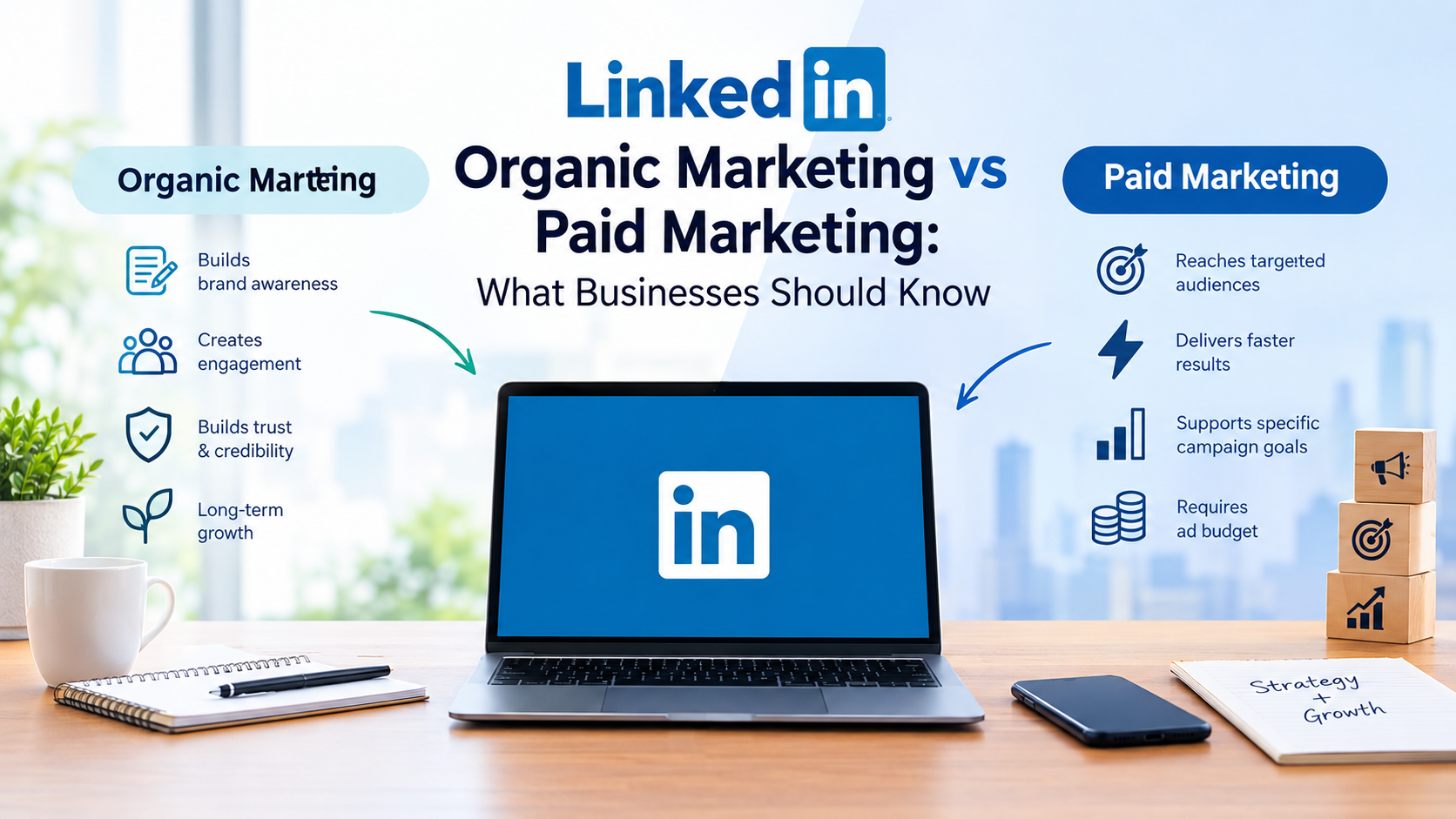
The biggest difference between LinkedIn organic vs paid marketing is how content reaches the audience.
Organic marketing relies on content quality, consistency, engagement, relationships, and the platform's distribution mechanisms. Paid marketing uses advertising budgets to place promotional content in front of selected audiences.
| Factor | LinkedIn Organic Marketing | LinkedIn Paid Marketing |
|---|---|---|
| Cost | No direct advertising cost | Requires advertising budget |
| Reach | Depends on content distribution and engagement | Can be expanded through paid campaigns |
| Speed | Usually takes time | Can generate visibility quickly |
| Trust | Helps build long-term credibility | Useful for targeted promotion |
| Targeting | More limited | More controlled audience targeting |
| Content | Educational and relationship-focused | Promotional and campaign-focused |
| Results | Often long-term | Can support short- and medium-term objectives |
| Lead Generation | Relationship-driven | Can be campaign-driven |
Benefits of LinkedIn Organic Marketing
1. Builds Long-Term Brand Visibility
Consistent content can help a business remain visible to its professional audience.
Instead of communicating only when a company has something to sell, organic content allows businesses to regularly share knowledge, opinions, insights, and useful information.
Over time, this can contribute to stronger brand recognition.
2. Helps Establish Industry Authority
Businesses can use organic content to demonstrate expertise.
For example, a digital marketing company can publish content about SEO, social media trends, content marketing, analytics, and customer acquisition.
When the content consistently provides useful information, it can help position the business as knowledgeable within its field.
3. Encourages Relationships
LinkedIn is fundamentally a professional networking platform. Organic marketing allows businesses to participate in conversations rather than simply displaying advertisements.
Commenting on relevant posts, responding to questions, sharing insights, and engaging with industry professionals can contribute to relationship building.
4. Cost-Effective for Consistent Marketing
Organic marketing does not require an advertising budget for every post.
Businesses can invest primarily in strategy, content creation, design, video production, and community management.
This makes organic LinkedIn marketing particularly useful for businesses that want to build a presence gradually.
Limitations of LinkedIn Organic Marketing
Organic marketing also has challenges.
A business can create high-quality content without necessarily receiving immediate reach or leads. Building an audience usually requires consistency and patience.
Other limitations can include:
- Results may take time
- Reach can vary between posts
- Consistent content creation is required
- Direct lead generation may be slower
- Audience growth can take time
Therefore, organic marketing is generally better viewed as a long-term marketing activity rather than a quick solution for immediate campaign objectives.
Benefits of LinkedIn Paid Marketing
1. Faster Audience Reach
One of the main advantages of paid marketing is the ability to distribute content to a selected audience through advertising.
This can be useful when a company needs to promote an offer, webinar, event, report, or service to a specific professional audience.
2. More Controlled Targeting
LinkedIn's professional audience data allows advertisers to build campaigns around relevant professional characteristics.
For B2B companies, this can be particularly useful because businesses often need to reach specific decision-makers rather than a broad consumer audience.
3. Supports Lead Generation Campaigns
Paid LinkedIn campaigns can be used as part of a lead-generation strategy.
For example, a company offering enterprise software could promote a downloadable industry report and use the campaign to attract professionals who may be relevant prospects.
4. Useful for Specific Campaign Objectives
Paid marketing can be particularly useful when a business has a defined objective and timeframe.
Examples include:
- Promoting a new service
- Generating registrations for an event
- Promoting a webinar
- Driving traffic to a landing page
- Reaching a specific professional audience
- Promoting downloadable resources
Limitations of LinkedIn Paid Marketing
Paid advertising also comes with challenges.
The most obvious requirement is budget. Businesses need to allocate advertising spending and monitor campaign performance carefully.
Other challenges include:
- Advertising costs can increase depending on competition
- Poor targeting can reduce campaign efficiency
- Ads require ongoing optimization
- Results depend on creative quality and offer relevance
- Paid visibility stops when the campaign ends
This means businesses should not assume that simply increasing the advertising budget will automatically produce better business results.
Which Is Better: Organic or Paid LinkedIn Marketing?
Instead of treating LinkedIn organic vs paid marketing as an either-or decision, businesses can consider how the two approaches complement each other.
Organic marketing can help establish credibility and maintain an ongoing presence, while paid marketing can provide additional reach for specific campaigns.
For example, a business could publish educational content organically throughout the month while using paid advertising to promote a major webinar or downloadable industry report.
This creates a combination of long-term brand building and targeted campaign promotion.
How Businesses Can Combine Organic and Paid Marketing
A practical LinkedIn marketing strategy can use both approaches.
Step 1: Build an Organic Content Foundation
Start by creating consistent content around the audience's interests and business expertise.
Content could include:
- Industry insights
- Educational posts
- Customer problems and solutions
- Case studies
- Company updates
- Expert opinions
- Short videos
- Data-driven insights
Step 2: Identify High-Performing Content
Monitor which organic posts receive meaningful engagement and audience interaction.
Content that performs well organically can provide useful information about topics that resonate with the audience.
Step 3: Create Targeted Paid Campaigns
Businesses can then develop paid campaigns around specific objectives.
Rather than promoting everything, focus advertising spending on campaigns with a clear purpose.
Step 4: Measure Business Outcomes
Do not evaluate LinkedIn marketing only through likes and impressions.
Depending on the objective, businesses can also monitor:
- Website visits
- Leads
- Conversion rates
- Cost per lead
- Engagement
- Content downloads
- Event registrations
- Qualified inquiries
Step 5: Continuously Optimize
LinkedIn marketing should be treated as an ongoing process.
Businesses can test different content formats, audiences, messages, creative approaches, landing pages, and calls to action to understand what generates meaningful results.
When Should a Business Focus on Organic Marketing?
Organic marketing can be particularly useful when the primary goal is:
- Building professional credibility
- Growing a brand presence
- Establishing thought leadership
- Developing relationships
- Educating an audience
- Maintaining consistent communication
Businesses that are willing to invest time in content and community building can use organic marketing as a foundation for their LinkedIn presence.
When Should a Business Consider Paid Marketing?
Paid marketing can be useful when a company has a specific campaign objective, defined audience, and advertising budget.
For example, paid marketing may be considered for:
- Product or service launches
- Webinar promotions
- Event registrations
- Lead-generation campaigns
- Downloadable resources
- Targeted B2B campaigns
- Brand awareness campaigns
The important point is that advertising should have a clearly defined objective rather than being used simply to increase visibility.
Final Thoughts
Understanding LinkedIn organic vs paid marketing can help businesses create a more balanced social media strategy. Organic marketing focuses on consistency, credibility, relationships, and long-term visibility, while paid marketing provides businesses with a way to support targeted campaigns and reach selected professional audiences.
For many businesses, the two approaches can work together. Organic content can create a foundation of trust and expertise, while paid campaigns can support specific business objectives.
The most effective LinkedIn marketing strategy ultimately depends on the company's goals, target audience, available resources, content capabilities, and campaign objectives. By tracking meaningful metrics and continuously improving their approach, businesses can make LinkedIn a more structured part of their overall digital marketing strategy.