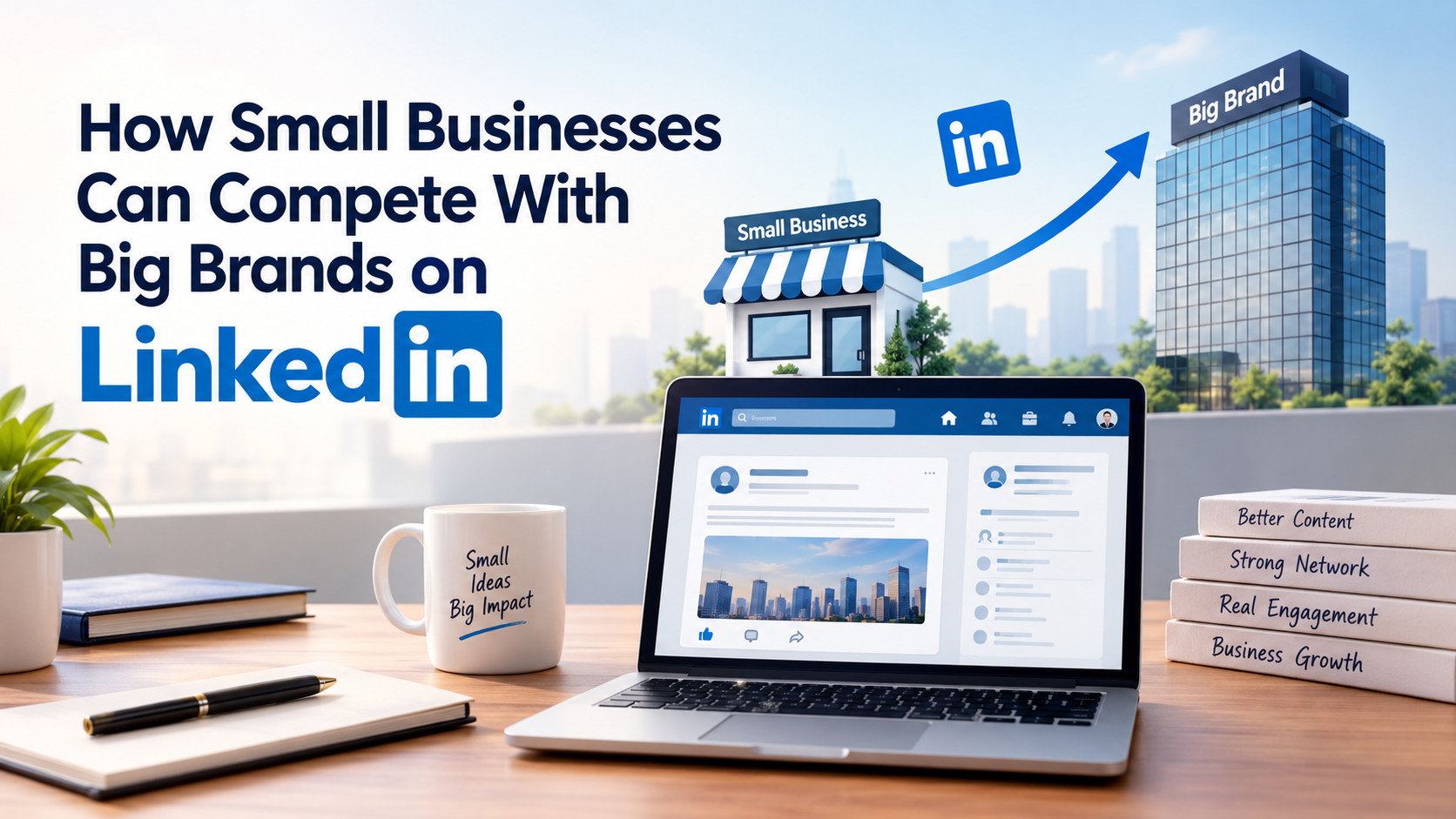
LinkedIn has become more than a platform for resumes and job hunting. It is now an important space for businesses to build authority, connect with decision-makers, generate leads, showcase expertise, and strengthen their online presence. For small businesses, this creates an opportunity to compete for attention with companies that have significantly larger marketing budgets.
However, competing with big brands does not mean trying to copy everything they do. Small businesses on LinkedIn can build an advantage by being more personal, responsive, focused, and authentic.
Large companies may have bigger teams and larger advertising budgets, but smaller businesses can often communicate more directly with their audience and respond faster to conversations and trends.
Why LinkedIn Matters for Small Businesses
LinkedIn provides access to professionals, entrepreneurs, founders, executives, recruiters, investors, and potential customers. This makes the platform particularly valuable for B2B companies and professional service providers.
A small company can use LinkedIn to:
- Build brand awareness
- Generate qualified leads
- Establish industry credibility
- Promote products and services
- Develop professional relationships
- Drive website traffic
- Showcase customer success stories
- Build founder and employee visibility
- Recruit talented professionals
The key is to approach LinkedIn as a relationship-building platform, rather than simply a place to publish promotional posts.
1. Focus on Expertise Instead of Company Size
One of the biggest mistakes small businesses make is believing they need to appear as large as their competitors.
They don't.
Instead of trying to look bigger, focus on demonstrating knowledge.
For example, a small digital marketing agency can publish content about:
- Common marketing mistakes
- Social media trends
- SEO lessons
- Campaign breakdowns
- Client challenges
- Marketing experiments
- Industry insights
- Practical business tips
When content consistently helps the audience solve problems, the business can gradually establish credibility.
Expertise can be more valuable than scale.
2. Build a Strong Founder or Employee Presence
One advantage smaller companies can have is the ability to put real people at the center of their LinkedIn strategy.
People often connect more easily with people than with corporate logos.
Founders, marketers, sales professionals, and employees can share:
- Lessons learned
- Industry opinions
- Behind-the-scenes experiences
- Customer stories
- Business challenges
- Professional achievements
- Educational content
- Personal experiences related to the industry
This approach can make a small business feel more approachable.
A company page can support the brand, but personal profiles can help create stronger professional relationships.
3. Create Content That Solves Real Problems
A successful LinkedIn content strategy should begin with the audience's problems.
Instead of repeatedly saying:
"We provide the best services."
Create content that answers questions your potential customers are already asking.
For example, a CRM company could create posts such as:
- "5 Signs Your Business Has Outgrown Spreadsheets"
- "Why Sales Teams Stop Using CRMs"
- "How CRM Automation Can Reduce Manual Work"
- "What to Track Before Choosing a CRM"
- "Common CRM Implementation Mistakes"
This type of content can attract people who are actively interested in the problem your product or service solves.
4. Use LinkedIn Personal Branding
LinkedIn personal branding can be particularly valuable for small businesses because it allows individuals to become recognizable representatives of their companies.
A founder could position themselves around a specific area of expertise.
For example:
Founder → Business Strategy
Marketing Manager → Digital Marketing
CRM Consultant → Sales Automation
HR Professional → Talent Management
The goal is not to talk about everything. Instead, consistently create content around a few relevant themes.
Over time, this can help establish a recognizable professional identity.
5. Choose a Specific Niche
Large brands often target broad markets.
Small businesses can sometimes compete more effectively by becoming highly relevant to a specific audience.
For example, instead of positioning yourself as:
"A digital marketing agency for everyone."
You could focus on:
"Digital marketing for early-stage SaaS companies."
Or:
"LinkedIn marketing for B2B consultants."
Or:
"CRM solutions for growing small businesses."
A focused positioning strategy makes it easier to create relevant content and attract a clearly defined audience.
6. Take Advantage of Organic LinkedIn Marketing
Big brands may have substantial advertising budgets, but small businesses can build visibility through consistent organic activity.
An organic strategy can include:
- Regular educational posts
- Thought leadership
- Employee-generated content
- Industry commentary
- Meaningful comments
- Direct networking
- Customer stories
- Case studies
- Short-form videos
- Document/carousel content
Consistency is important.
Publishing one post and disappearing for three weeks is unlikely to create a strong presence.
A realistic starting point could be 3–5 quality posts per week, combined with daily engagement.
7. Become Active in the Comments
One of the simplest ways for small businesses on LinkedIn to increase visibility is by participating in relevant conversations.
Instead of only publishing your own content, identify posts from:
- Industry leaders
- Potential customers
- Founders
- Decision-makers
- Relevant companies
- Industry publications
Then contribute useful comments.
Avoid generic comments such as:
"Great post!"
Instead, add an observation, example, question, or useful perspective.
For example:
"One important point here is that CRM adoption often depends more on workflow simplicity than the number of features. If the sales team finds the system difficult to use, adoption can quickly decline."
A thoughtful comment can introduce your expertise to people who may not have discovered your profile otherwise.
8. Share Customer Success Stories
Small businesses can build credibility by showing evidence of the value they provide.
Instead of simply saying:
"Our service helps businesses grow."
Show what happened.
A case study can explain:
Challenge → Solution → Process → Result → Lesson
For example:
A growing business was struggling with scattered customer information. After implementing a centralized CRM workflow, the team was able to organize customer data, automate follow-ups, and create a more structured sales process.
Where possible, use accurate and verifiable numbers. Avoid making exaggerated claims.
9. Use Employee-Generated Content
Your employees can become an extension of your marketing team.
Different employees can discuss different aspects of the business.
For example:
Founder: Business vision and industry insights
Marketing Team: Marketing strategies and trends
Sales Team: Customer problems and sales lessons
Product Team: Product development and innovation
HR Team: Workplace culture and hiring
This can create a more diverse LinkedIn presence while making the company feel more human.
10. Engage Before You Sell
One of the biggest mistakes businesses make on LinkedIn is immediately trying to sell.
A better approach is:
Connect → Engage → Provide Value → Build Trust → Start a Conversation → Present an Offer
For example, if someone regularly interacts with your content, you don't necessarily need to immediately send a sales pitch.
You could start with a relevant conversation.
This makes LinkedIn networking feel more natural and less transactional.
11. Use Data to Improve Your Strategy
Posting consistently is only part of the process.
Small businesses should also analyze what works.
Track metrics such as:
- Post impressions
- Engagement rate
- Comments
- Shares
- Profile views
- Follower growth
- Website visits
- Leads generated
- Connection growth
- Conversion rate
Don't focus only on impressions.
A post with 10,000 impressions but no relevant engagement may be less valuable than a post with 2,000 impressions that generates several qualified business conversations.
The right metrics depend on your business objectives.
12. Create a Repeatable LinkedIn Content System
Creating every post from scratch can become difficult.
Instead, develop a repeatable content system.
For example:
Monday: Industry insight
Tuesday: Educational carousel
Wednesday: Founder story
Thursday: Customer problem/solution
Friday: Industry opinion or business lesson
You can also create content pillars.
Content Pillar 1: Education
Teach your audience something useful.
Content Pillar 2: Expertise
Share your professional knowledge and opinions.
Content Pillar 3: Proof
Show customer results, case studies, testimonials, or projects.
Content Pillar 4: People
Show founders, employees, company culture, and behind-the-scenes activities.
Content Pillar 5: Product or Service
Explain how your offering solves specific problems.
This creates a balanced content strategy without making every post promotional.
13. Use LinkedIn Video to Build Familiarity
Short-form video can help businesses communicate ideas quickly.
A small business could create 30–60 second videos around topics such as:
- One marketing tip
- One common business mistake
- Industry news
- Quick tutorials
- Founder lessons
- Frequently asked questions
- Product demonstrations
- Customer problems
The objective doesn't have to be viral reach.
The goal can simply be to become more recognizable to the right audience.
14. Build Relationships With Industry Professionals
LinkedIn is fundamentally a professional networking platform.
Small businesses can connect with:
- Potential customers
- Partners
- Consultants
- Entrepreneurs
- Investors
- Industry experts
- Journalists
- Recruiters
- Service providers
However, networking should be relevant.
Rather than sending hundreds of random connection requests, identify people who are genuinely relevant to your business and personalize your interactions.
Quality relationships can become more valuable than a large follower count.
15. Compete Through Speed and Authenticity
Big brands have resources, but larger organizations can sometimes have slower decision-making processes.
Small businesses can use their flexibility as an advantage.
If an important industry topic emerges, a small business can potentially create a useful post quickly.
If a customer asks a question, the business can respond personally.
If an employee has an interesting experience, it can become content.
This flexibility can help smaller companies maintain a more active and human presence.
Common LinkedIn Mistakes Small Businesses Should Avoid
Posting Only Promotional Content
Constantly promoting products and services can make your page feel like an advertisement.
Balance promotional content with education and insights.
Buying Followers
A large follower count does not automatically mean a strong LinkedIn presence.
Relevant connections and meaningful engagement are more useful for business growth.
Copying Big Brands
Your strategy should reflect your audience, expertise, and resources.
Don't copy a multinational company's content strategy simply because it has a large following.
Ignoring Personal Profiles
Employees and founders can play an important role in increasing brand visibility.
Posting Without a Strategy
Random content can make it difficult to build a recognizable brand.
Create content pillars and a publishing schedule.
Focusing Only on Likes
Likes are only one engagement signal.
Look at comments, conversations, profile visits, website traffic, and qualified leads as well.
A Simple LinkedIn Strategy for Small Businesses
A practical strategy could look like this:
Step 1: Define your target audience.
Step 2: Identify their biggest problems.
Step 3: Select 3–5 content pillars.
Step 4: Optimize your company and personal profiles.
Step 5: Publish valuable content consistently.
Step 6: Engage with relevant professionals every day.
Step 7: Share proof through case studies and customer stories.
Step 8: Build relationships before making sales pitches.
Step 9: Track performance.
Step 10: Improve your content based on the data.
Final Thoughts
Small businesses on LinkedIn do not need the same resources as big brands to build a meaningful presence. Instead, they can compete for attention by focusing on expertise, consistency, personal branding, useful content, authentic engagement, and strong professional relationships.
The objective should not simply be to accumulate followers. A successful LinkedIn presence should help the business become more visible to the right audience, demonstrate expertise, create meaningful conversations, and eventually support business objectives such as lead generation and customer acquisition.
With a focused LinkedIn marketing strategy, even a small team can build a credible professional brand and create opportunities that extend far beyond the size of its marketing budget.