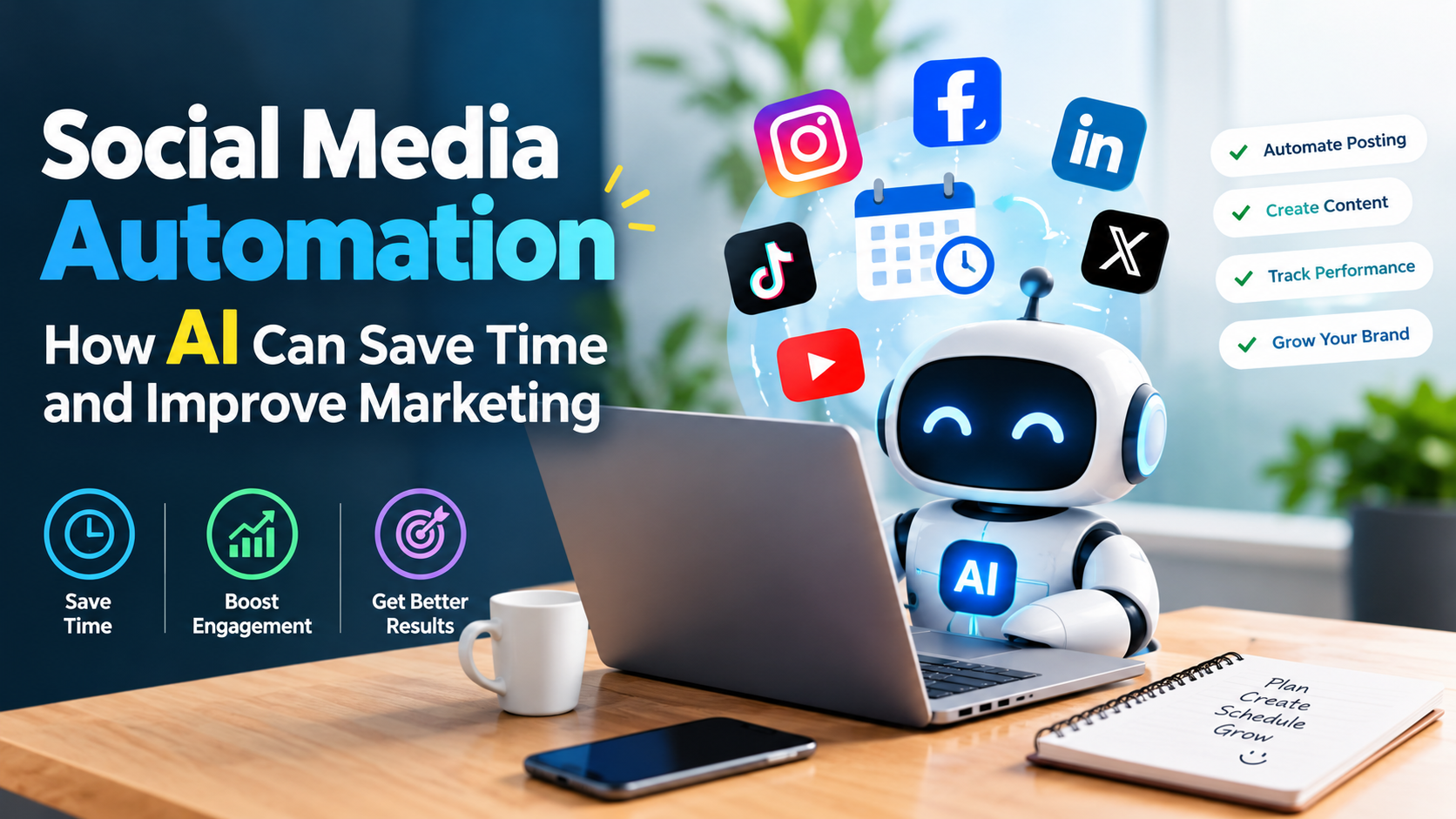
Social Media Automation is changing the way businesses manage their digital marketing activities. From scheduling posts and generating content ideas to analyzing performance and responding to customers, artificial intelligence can help businesses reduce repetitive work and improve marketing efficiency.
Managing multiple social media platforms manually can be time-consuming. Marketing teams often need to research topics, create content, design posts, write captions, schedule publications, monitor engagement, and analyze results. As a business grows, managing all these activities consistently becomes increasingly difficult.
AI-powered automation can help simplify many of these processes. Instead of replacing marketers, AI can act as a productivity tool that handles repetitive tasks while marketing teams focus on strategy, creativity, customer relationships, and business growth.
What Is Social Media Automation?
Social media automation involves using software and technology to perform repetitive social media marketing tasks with limited manual intervention.
Common automated activities include:
- Scheduling social media posts
- Publishing content at predetermined times
- Organizing content calendars
- Generating content ideas
- Creating caption drafts
- Monitoring mentions and interactions
- Collecting performance data
- Identifying engagement patterns
- Sending automated responses
- Repurposing existing content
When AI is added to automation, these systems can become more intelligent. AI tools can analyze information, identify patterns, generate content suggestions, and assist marketers with decisions.
Why Social Media Automation Matters
Social media marketing requires consistency. However, consistently creating and publishing content can take significant time.
A business may need to maintain several platforms simultaneously. Each platform can require different formats, captions, posting schedules, and content approaches.
Social Media Automation can help reduce the amount of repetitive manual work involved.
For example, a marketing team can prepare a week's or month's content in advance and schedule it across relevant platforms. AI can then assist with caption ideas, content variations, audience insights, and performance analysis.
This creates a more organized marketing workflow.
1. AI Can Help Generate Content Ideas
Coming up with fresh content ideas every day can be challenging.
AI tools can help marketers brainstorm topics based on:
- Target audience interests
- Industry trends
- Frequently asked questions
- Customer problems
- Existing content
- Seasonal events
- Product features
- Educational topics
For example, a software company could use AI to generate content ideas around productivity, automation, cybersecurity, business software, and industry trends.
However, AI-generated ideas should still be reviewed by marketers to ensure that they are accurate, relevant, and aligned with the brand.
2. Automate Social Media Scheduling
One of the simplest applications of Social Media Automation is content scheduling.
Instead of manually publishing every post, businesses can prepare content in advance and schedule it for specific dates and times.
This can help businesses:
- Maintain consistency
- Reduce daily workload
- Organize campaigns
- Plan content around important dates
- Avoid missing publishing deadlines
For marketing teams managing several accounts, scheduling can significantly simplify daily operations.
3. AI Can Assist With Caption Creation
Writing social media captions for every post can become repetitive.
AI can help create initial caption drafts based on information such as:
- Topic
- Brand voice
- Target audience
- Content format
- Call to action
- Platform
For example, the same business announcement could be adapted into different versions for LinkedIn, Instagram, and Facebook.
Human review remains important because the final caption should reflect the company's personality and avoid generic or inaccurate messaging.
4. Automate Content Repurposing
Businesses already create valuable content in the form of blogs, videos, webinars, case studies, and reports.
AI can help transform one piece of content into multiple social media assets.
For example:
One blog post →
- LinkedIn post
- Instagram carousel
- Short-form video script
- X post
- Quote graphic
- Email content
This approach allows businesses to maximize the value of existing content without creating everything from scratch.
5. Improve Customer Engagement
Social media automation can also support customer communication.
Automated systems can help acknowledge common inquiries, direct users toward relevant information, and organize incoming messages.
For example, a chatbot can answer basic questions such as:
- What services do you provide?
- What are your business hours?
- How can I request a demo?
- Where can I learn more?
- How can I contact your team?
More complex questions can then be transferred to a human representative.
This combination of automation and human support can improve response efficiency without removing the human element from customer relationships.
6. Use AI for Social Media Analytics
Collecting social media data is relatively easy. Understanding what that data means is more valuable.
AI-powered analytics can help marketers identify patterns in:
- Engagement
- Reach
- Audience behavior
- Content performance
- Clicks
- Conversions
- Video views
- Follower growth
For example, if educational videos consistently generate more engagement than promotional posts, a business may decide to increase its educational content.
Data can therefore help marketers make more informed content decisions.
7. Automate Repetitive Marketing Workflows
AI can become particularly useful when several marketing activities are connected.
A simplified workflow could look like:
Content Idea → AI-Assisted Draft → Human Review → Scheduling → Publishing → Engagement Monitoring → Performance Analysis
This workflow reduces repetitive tasks while keeping important strategic and creative decisions under human control.
Businesses can also create workflows that connect social media activity with lead generation and customer relationship processes.
For example:
Social Media Post → Landing Page → Lead Form → Notification → Sales Follow-Up
This can help create a more organized path from social media visibility to potential customer acquisition.
8. AI Can Help Personalize Content
Different audiences respond to different messages.
AI can help marketers analyze audience behavior and develop content variations for different customer segments.
For example, a software company may communicate differently with:
- Startup founders
- Marketing managers
- Sales teams
- Enterprise decision-makers
Instead of using exactly the same message for everyone, marketers can create more relevant variations while maintaining consistent brand positioning.
9. Automation Saves Valuable Time
One of the biggest benefits of Social Media Automation is time efficiency.
Consider the number of repetitive activities involved in managing social media:
Without automation:
Research → Write → Design → Schedule → Publish → Monitor → Analyze
With automation:
Plan → AI-assisted creation → Review → Schedule → Monitor → Optimize
Automation does not eliminate the need for marketers. Instead, it allows them to spend more time on higher-value activities such as strategy, creative direction, customer research, campaign planning, and business development.
10. Automation Should Not Mean Fully Automated Marketing
Businesses should be careful not to automate everything.
Social media is fundamentally about communication between people and brands. Excessive automation can make content feel repetitive, generic, or impersonal.
Human involvement is still important for:
- Brand strategy
- Creative decisions
- Sensitive customer conversations
- Crisis communication
- Community building
- Fact-checking
- Final content approval
The best approach is usually AI-assisted marketing rather than completely AI-controlled marketing.
Best Practices for AI-Powered Social Media Automation
Businesses can follow several practices to make automation more effective.
Define Your Brand Voice
Create clear guidelines for tone, language, messaging, and visual identity before using AI to generate content.
Review AI-Generated Content
AI-generated content should be checked for accuracy, relevance, originality, and brand consistency.
Maintain a Human Connection
Use automation for repetitive tasks while keeping meaningful conversations human.
Monitor Performance
Track engagement, traffic, leads, and conversions to determine which automated workflows are actually useful.
Protect Customer Data
Businesses should use appropriate security practices when automation systems process customer or business information.
Keep Improving
Automation workflows should be regularly reviewed and updated based on performance and changing business requirements.
The Future of Social Media Automation
The role of AI in marketing is likely to continue expanding. Businesses are increasingly using AI for content creation, analytics, customer support, personalization, workflow automation, and campaign optimization.
However, technology alone does not create a successful marketing strategy.
Businesses still need a clear understanding of their audience, strong positioning, useful content, creative thinking, and meaningful customer relationships.
AI can make these processes more efficient, but human strategy remains essential.
Conclusion
Social Media Automation can help businesses save time, improve consistency, streamline content workflows, and make better use of marketing data. AI can assist with everything from content ideation and caption creation to scheduling, analytics, personalization, and customer support.
The goal should not be to automate social media completely. Instead, businesses should identify repetitive tasks that technology can handle while allowing marketing teams to focus on creativity, strategy, relationships, and growth.
When implemented thoughtfully, AI-powered social media automation can turn a time-consuming marketing process into a more organized, scalable, and efficient system.