Customer expectations are changing rapidly. People want quick answers, convenient communication, and reliable assistance whenever they need it. For businesses, meeting these expectations while controlling operational costs has become an important challenge.
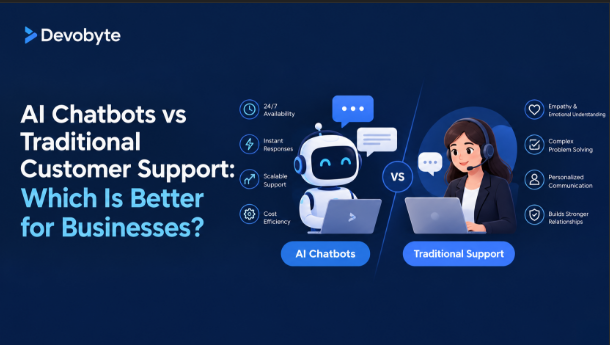
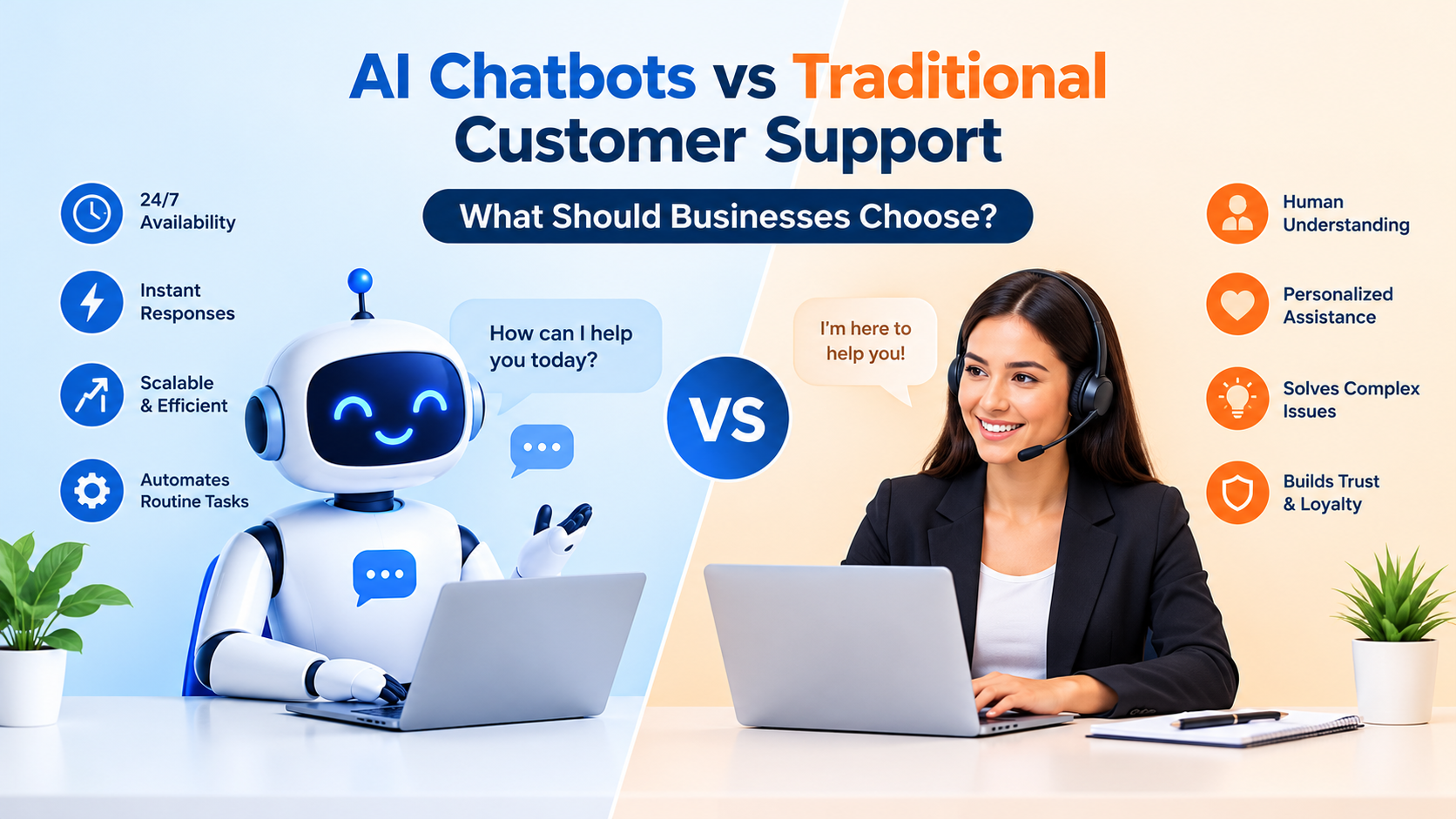
This is where the debate around AI chatbots vs traditional customer support becomes relevant. AI chatbots can respond to common questions automatically, while traditional customer support relies on human representatives to understand customer concerns, offer personalized assistance, and resolve complex issues.
Both approaches have advantages and limitations. Choosing the right one depends on a company's customer base, support requirements, budget, and long-term business goals.
In this blog, we will compare AI chatbots and traditional customer support to help businesses determine which approach best fits their needs.
What Are AI Chatbots?
AI chatbots are software applications designed to communicate with customers through text or, in some cases, voice. They can answer questions, guide users through processes, provide product information, and automate repetitive customer service tasks.
Modern AI chatbots can use natural language processing (NLP), machine learning, and large language models to understand customer questions and generate relevant responses.
Businesses commonly use AI chatbots on websites, mobile applications, messaging platforms, and e-commerce stores.
Key benefits of AI chatbots
-
24/7 availability: Customers can receive assistance outside regular business hours.
-
Faster responses: Chatbots can answer common questions almost instantly.
-
Scalability: They can handle multiple conversations simultaneously.
-
Task automation: They can assist with FAQs, order tracking, appointment scheduling, and lead qualification.
-
Consistent answers: Properly configured chatbots can deliver standardized information across customer interactions.
-
Reduced repetitive workload: They can help human agents focus on more complex customer issues.
However, AI chatbots are not perfect. They may misunderstand unclear questions, generate inaccurate responses, or struggle with sensitive situations. Businesses should establish clear escalation processes so customers can reach a human representative when necessary.
What Is Traditional Customer Support?
Traditional customer support involves human representatives who communicate directly with customers to answer questions, troubleshoot problems, handle complaints, and provide guidance.
This support can be delivered through phone calls, emails, live chat, or in-person interactions.
Unlike automated systems, human agents can consider emotional context, ask follow-up questions, exercise judgment, and adapt their approach to individual situations.
Key benefits of traditional customer support
-
Human understanding: Representatives can recognize frustration, urgency, and emotional concerns.
-
Personalized assistance: Agents can adapt explanations and recommendations to individual needs.
-
Complex problem-solving: Experienced representatives can investigate unusual issues that require judgment.
-
Relationship building: Direct communication can strengthen customer trust and loyalty.
-
Greater flexibility: Human agents can handle exceptions and situations that fall outside standard workflows.
Traditional support also has limitations. It may involve higher staffing costs, longer waiting times during peak periods, limited operating hours, and challenges in scaling operations quickly.
AI Chatbots vs Traditional Customer Support: Key Differences
The following comparison highlights how both approaches perform across important business requirements.
|
Factor |
AI Chatbots |
Traditional Support |
|---|---|---|
|
Availability |
Can operate 24/7 |
Depends on staffing and schedules |
|
Response time |
Usually immediate |
May involve waiting |
|
Scalability |
Handles many conversations simultaneously |
Requires sufficient agent capacity |
|
Operating costs |
Setup, integration, usage, and maintenance costs |
Salaries, training, management, and infrastructure |
|
Personalization |
Depends on context and system capabilities |
Human judgment and direct interaction |
|
Complex issues |
Best for supported workflows; may struggle with exceptions |
Better suited to nuanced problems |
|
Emotional understanding |
Limited and imperfect |
Human empathy and judgment |
|
Consistency |
Can follow defined response guidelines |
Varies by agent and training |
|
Best use cases |
FAQs, routine requests, basic qualification |
Complaints, sensitive issues, complex troubleshooting |
Neither approach is automatically superior in every situation. The right choice depends on the type of customer interaction and the quality of implementation.
1. Response Time and Availability
Response time plays an important role in customer satisfaction. When customers need information about a product, order, service, or payment, unnecessary delays can create frustration.
AI chatbots can provide immediate responses to common questions and remain available beyond normal business hours. For example, an online store can use a chatbot to explain shipping policies or guide customers through order tracking at midnight.
Traditional support may require customers to wait until an agent becomes available. However, a knowledgeable human representative may resolve a difficult problem more effectively than a chatbot that provides a quick but incomplete answer.
Which is better? AI chatbots generally have the advantage in availability and speed for routine questions, while human support remains valuable when a customer needs detailed assistance.
2. Cost and Operational Efficiency
Customer support can become expensive as a business grows. Hiring employees, providing training, managing schedules, and maintaining support infrastructure all require resources.
AI chatbots can automate repetitive interactions, potentially reducing the amount of manual work required from support teams. Businesses can then allocate human agents to higher-value activities.
However, chatbot implementation is not free. Expenses may include software subscriptions, development, integration, AI usage, ongoing maintenance, testing, and human oversight.
Traditional support involves recurring employee and management costs, but it can provide significant value when interactions require expertise or personal attention.
Which is better? AI chatbots may improve cost efficiency when a large proportion of customer questions are repetitive. Businesses should evaluate total operating costs and resolution quality rather than assuming automation is always cheaper.
3. Customer Experience and Personalization
A good customer experience requires more than a fast response. Customers also want accurate information, clear explanations, and solutions that address their specific needs.
AI chatbots can personalize interactions when connected to relevant customer information, purchase history, or a CRM system, subject to appropriate permissions and privacy safeguards. They can use this context to guide customers toward relevant products or provide updates about existing requests.
Human agents can interpret more subtle details, recognize emotional concerns, and adapt their communication style in real time. This is particularly important when customers are upset or dealing with complicated issues.
Which is better? Chatbots can provide convenient, context-aware assistance, while human representatives often have an advantage in sensitive situations and conversations requiring empathy.
4. Handling Complex Customer Problems
Not every customer question can be resolved with a standard answer.
A customer may experience a billing dispute, a technical failure, a delayed delivery, or an unexpected service problem. Resolving these situations may require investigation, policy interpretation, coordination between departments, or a decision outside a predefined workflow.
AI chatbots can guide customers through structured troubleshooting steps and gather information before escalating an issue. Advanced systems may also assist agents by summarizing conversations or retrieving relevant knowledge.
Nevertheless, a chatbot should not confidently invent a solution when it lacks the necessary information.
Human agents are particularly useful for cases involving exceptions, ambiguous situations, complaints, and decisions that require accountability.
Which is better? Traditional support is generally preferable for complex or sensitive cases, with AI assisting where appropriate.
5. Scalability and Business Growth
As a company attracts more customers, the volume of support requests can increase significantly. Managing this growth without compromising service quality is a major operational challenge.
AI chatbots can handle multiple conversations simultaneously, making them useful during product launches, seasonal sales, marketing campaigns, and other periods of high demand.
Traditional support teams can also scale, but doing so may require recruiting, training, scheduling, and managing additional employees.
Still, scalability is not just about handling more conversations. Businesses must also ensure that answers remain accurate and that unresolved requests reach the right person.
Which is better? AI chatbots offer an advantage for high-volume routine inquiries, while a well-managed human team remains important for quality control and difficult cases.
6. Data Collection and CRM Integration
Customer conversations can reveal common problems, product concerns, purchasing interests, and opportunities to improve service.
When integrated with a customer relationship management (CRM) platform, AI chatbots can capture relevant information, qualify leads, record interactions, and route inquiries to the appropriate department.
For example, a chatbot on a software company's website could ask about a visitor's business needs, identify their preferred solution, and direct a qualified prospect to the sales team.
Human agents can contribute valuable insights through detailed conversations and feedback about recurring customer issues.
Businesses must manage customer data responsibly, apply suitable access controls, and follow applicable privacy requirements when collecting or using this information.
Which is better? Both can contribute valuable customer insights. AI chatbots can automate structured data collection, while human agents can provide additional context that may be difficult to capture through automated interactions.
When Should Businesses Choose AI Chatbots?
AI chatbots can be a strong option when businesses need to manage repetitive inquiries, provide round-the-clock information, or support a growing number of customers.
Consider using AI chatbots when:
-
Your business receives a high volume of frequently asked questions.
-
Customers regularly request order updates, booking information, or basic product details.
-
You want to provide assistance outside normal business hours.
-
Your team spends substantial time answering the same questions.
-
You need to qualify leads before assigning them to sales representatives.
-
Your website requires a faster way to guide visitors toward relevant information.
For example, an e-commerce business can use chatbots to answer questions about shipping, returns, product availability, and delivery status. Human representatives can then focus on damaged orders, disputed refunds, and other exceptions.
When Should Businesses Choose Traditional Customer Support?
Human-led support remains essential when the quality of an interaction depends on personal understanding, expert judgment, or flexibility.
Consider traditional customer support when:
-
Your products or services require detailed technical guidance.
-
Customers frequently raise complicated complaints.
-
Your business handles sensitive financial or personal matters.
-
Customers expect relationship-based service.
-
Issues require negotiation, discretion, or policy exceptions.
-
Incorrect automated answers could create significant financial or reputational consequences.
For example, a business software provider may automate password-reset guidance while assigning complicated integration failures to experienced technical support agents.
Why a Hybrid Customer Support Model Often Works Best
For many businesses, the choice does not have to be between AI chatbots and human representatives. A hybrid customer support model combines automation with human expertise.
In this model, AI handles routine questions and initial information gathering, while human agents take over when an issue becomes complex or requires personal attention.
Step 1: AI handles the first interaction
The chatbot welcomes the customer, identifies the request, and answers common questions.
Step 2: The system identifies the next action
The chatbot uses approved workflows to resolve the request or recognize when escalation is necessary.
Step 3: A human agent takes over when needed
The agent receives the conversation history and relevant details, reducing the need for customers to repeat themselves.
Step 4: The business measures performance
The team tracks resolution rates, customer satisfaction, response times, and escalation patterns to improve the experience.
This approach helps businesses automate suitable tasks without removing human assistance from situations where it matters most.
For successful implementation, companies should make the option to contact a human easy to find, keep chatbot responses grounded in reliable information, and regularly review failed or incomplete conversations.
How to Choose the Right Customer Support Solution
Before investing in a chatbot platform or expanding a support team, businesses should evaluate their existing operations.
1. Identify common customer questions
Review support tickets, emails, calls, and live chats. Determine which questions are repetitive and which require investigation or judgment.
2. Evaluate your budget
Compare the total cost of chatbot implementation and maintenance with the cost of staffing, training, and managing a human support team.
3. Understand customer expectations
Some customers prefer self-service for simple requests, while others want direct contact with a representative. Offer support channels that match your audience's needs.
4. Review integration requirements
Check whether the solution can connect with your CRM, help desk, order management system, or knowledge base. Integration can reduce manual work and help maintain consistent customer information.
5. Establish escalation rules
Define when the chatbot should transfer a conversation to a human. Complaints, repeated failed answers, sensitive requests, and complex technical issues may require escalation.
6. Measure results after implementation
Monitor key performance indicators such as:
-
First response time
-
First-contact resolution rate
-
Customer satisfaction score (CSAT)
-
Average resolution time
-
Chatbot containment rate
-
Escalation rate
-
Cost per resolved interaction
Evaluate these metrics together. A chatbot that resolves many conversations automatically is not necessarily successful if customers receive inaccurate answers or struggle to reach human support.
Common Mistakes Businesses Should Avoid
Even a promising customer support solution can underperform when it is implemented without a clear strategy.
Replacing every human interaction with automation: Some situations require empathy, professional judgment, or individual attention.
Using outdated information: Chatbots need reliable, regularly maintained knowledge sources to provide useful answers.
Making escalation difficult: Customers should not have to repeat themselves endlessly or navigate confusing menus to reach an agent.
Ignoring customer feedback: Reviews, complaints, and unresolved conversations can reveal problems with chatbot responses and support processes.
Measuring speed alone: Fast answers have limited value if they do not solve the customer's problem.
Ignoring data privacy: Businesses should apply appropriate security, data retention, consent, and access-control practices to customer interactions.
Avoiding these mistakes helps companies create a support experience that prioritizes both operational efficiency and customer trust.
The Future of Customer Support: AI and Human Collaboration
Customer support is moving toward more connected and intelligent workflows. AI tools can increasingly assist with answering routine questions, summarizing conversations, recommending next steps, and helping agents find relevant information.
As these systems become integrated with CRM platforms and business applications, customer support may become more proactive. For example, a business could identify recurring service issues, detect a customer's unresolved request, or direct a conversation to the most appropriate team.
However, technology alone does not guarantee better service. Businesses still need accurate information, responsible data practices, well-defined workflows, and trained employees who can manage situations requiring human judgment.
The strongest long-term strategy is to use AI where it provides clear value while preserving meaningful human support.
Conclusion
The comparison of AI chatbots vs traditional customer support shows that both approaches serve important purposes.
AI chatbots are useful for immediate responses, repetitive questions, automation, and handling high volumes of routine interactions. Traditional customer support is valuable for complex problem-solving, emotional understanding, personalized assistance, and situations requiring human judgment.
For many growing businesses, a hybrid approach offers a practical balance. Automating routine tasks can help improve efficiency, while human representatives remain available for customers who need more detailed support.
Ultimately, businesses should choose their customer support strategy based on customer expectations, operational requirements, available resources, and measurable results. The goal is not simply to automate more interactions, but to resolve customer problems effectively and build lasting trust.
Frequently Asked Questions (FAQs)
1. Are AI chatbots better than traditional customer support?
AI chatbots are often better for repetitive questions, immediate responses, and round-the-clock availability. Traditional support is generally better for complex problems, sensitive conversations, and situations requiring human judgment. The best option depends on the business and its customers.
2. Can AI chatbots completely replace customer support agents?
AI chatbots can automate many routine support tasks, but they cannot reliably handle every customer situation. Human agents remain important for complicated issues, complaints, exceptions, and interactions requiring empathy or accountability.
3. Are AI chatbots cost-effective for small businesses?
They can be, particularly when a small business receives frequent repetitive inquiries and needs support outside business hours. However, businesses should compare software, integration, usage, and maintenance expenses against the actual savings and service improvements.
4. How do AI chatbots improve customer experience?
They can reduce waiting times, provide self-service assistance, answer common questions, and guide customers through routine processes. When connected to reliable customer data, they may also provide more relevant responses.
5. What is a hybrid customer support model?
A hybrid customer support model combines AI automation with human assistance. Chatbots handle routine interactions, while human agents manage complex or sensitive cases, allowing businesses to balance efficiency with personalized service.
6. Which industries can benefit from AI chatbots?
E-commerce, software, education, travel, hospitality, banking, and professional services can benefit from chatbots for suitable tasks such as answering FAQs, booking appointments, providing service updates, and qualifying leads. Regulated and sensitive use cases require additional safeguards.