Customer expectations have changed significantly in recent years. People want quick answers, convenient communication, and support whenever they need it. For businesses, providing fast and reliable customer service has become an important part of building trust and retaining customers.
Traditionally, businesses relied on customer support teams to answer questions, resolve complaints, process requests, and provide assistance. While human customer support remains valuable, the rise of artificial intelligence (AI) has introduced a new option: AI chatbots.
AI chatbots can communicate with customers, answer frequently asked questions, provide information, guide users through processes, and handle repetitive support requests. This has made many businesses question whether they should continue relying primarily on traditional customer support or invest in AI-powered solutions.
So, AI chatbots vs traditional customer support: which is better for businesses?
The answer depends on the type of business, customer expectations, support requirements, and complexity of customer queries. In many cases, the most effective approach is not choosing one over the other but combining AI automation with human expertise.
What Are AI Chatbots?
AI chatbots are software applications that use artificial intelligence and natural language processing to communicate with users through text or, in some cases, voice.
Unlike basic rule-based chatbots that can only respond to predefined commands, modern AI chatbots can understand variations in customer questions and generate relevant responses.
Businesses can use AI chatbots for tasks such as:
-
Answering frequently asked questions
-
Providing product or service information
-
Helping customers navigate websites
-
Tracking orders or service requests
-
Collecting customer information
-
Scheduling appointments
-
Qualifying leads
-
Providing basic troubleshooting
-
Routing complex queries to human agents
For example, an e-commerce company can use a chatbot to answer questions about delivery times, return policies, payment methods, and order status without requiring a customer service representative to handle every request.
What Is Traditional Customer Support?
Traditional customer support generally involves human representatives communicating with customers through phone calls, emails, live chat, or social media.
Human agents can understand context, emotions, and unusual situations that may be difficult for automated systems to handle.
Traditional customer support is particularly useful when customers have:
-
Complex problems
-
Complaints requiring judgment
-
Technical issues
-
Sensitive concerns
-
Account-related problems
-
Unique requests
-
Situations requiring negotiation or empathy
Human interaction can also help businesses create stronger relationships with customers, particularly in industries where trust and personal communication are important.
AI Chatbots vs Traditional Customer Support: Key Differences
Understanding the differences between AI chatbots and traditional customer support can help businesses decide how to structure their customer service strategy.
1. Availability
One of the biggest advantages of AI chatbots is availability.
A chatbot can potentially assist customers 24/7, including weekends and holidays. Customers do not necessarily have to wait until business hours to receive an answer.
Traditional customer support, on the other hand, usually depends on employee working hours. Businesses can provide 24/7 human support, but doing so generally requires additional staff, shifts, and operational resources.
For businesses with customers across different time zones, chatbot availability can be particularly useful.
2. Response Time
Customers increasingly expect quick responses.
AI chatbots can respond almost instantly to common questions. This reduces waiting time and allows customers to receive basic information without joining a queue.
Human agents may need more time, especially during periods of high customer demand.
However, speed should not come at the cost of accuracy or customer experience. If a chatbot provides an incorrect or irrelevant response, customers may become frustrated.
3. Cost Efficiency
Customer support teams require salaries, training, management, software, and infrastructure. As a business grows, maintaining a large support team can become expensive.
AI chatbots can automate repetitive interactions and reduce the number of simple requests that require human intervention.
For example, instead of having an employee answer hundreds of similar questions about business hours or return policies, a chatbot can handle those requests automatically.
This doesn't necessarily mean businesses should eliminate customer support employees. Instead, automation can allow employees to focus on more valuable and complex tasks.
4. Personalization
Human customer support has traditionally had an advantage when it comes to personalized communication.
A trained customer service representative can understand the customer's situation, ask follow-up questions, and adjust their communication style accordingly.
Modern AI chatbots are becoming increasingly capable of personalization when they have access to relevant customer and business data. However, their effectiveness depends heavily on the quality of their training, integrations, and implementation.
For high-value customers or complex situations, human interaction may still be more appropriate.
5. Handling Complex Problems
This is one area where human support remains highly important.
A chatbot may be excellent at answering routine questions but struggle when a customer presents an unusual or complicated problem.
For example, imagine a customer has received a damaged product, the refund has been delayed, and the order contains multiple items. Resolving the issue may require judgment, investigation, and communication between different departments.
A human agent can analyze the situation and make decisions based on context.
The best chatbot systems should therefore provide an easy option for customers to connect with a human agent when necessary.
Advantages of AI Chatbots for Businesses
AI chatbots offer several potential benefits for modern businesses.
24/7 Customer Assistance
Businesses can provide basic support outside normal working hours without requiring employees to remain available around the clock.
Reduced Workload
Chatbots can handle repetitive questions, allowing customer support teams to focus on complicated requests.
Faster Responses
Customers can receive immediate answers to common questions instead of waiting for an available agent.
Scalability
A chatbot can handle multiple conversations simultaneously. This can be particularly useful during product launches, seasonal sales, marketing campaigns, or periods of increased website traffic.
Lead Generation
AI chatbots aren't limited to customer service. Businesses can also use them to collect information from website visitors, identify potential leads, and direct prospects toward relevant products or services.
Consistent Information
A well-designed chatbot can provide standardized responses based on approved business information, helping reduce inconsistencies in basic customer communication.
Advantages of Traditional Customer Support
Despite the growth of AI, human customer support continues to play an important role.
Empathy and Emotional Understanding
Customers sometimes contact support because they are frustrated, worried, or disappointed. Human representatives can respond with empathy and adjust their communication based on the customer's emotional state.
Complex Problem Solving
Human agents can investigate complicated issues and make decisions that require judgment.
Relationship Building
For businesses that depend on long-term customer relationships, personal communication can make customers feel valued.
Handling Exceptions
Not every customer situation fits into a predefined process. Human agents can deal with unusual requests and exceptions more effectively.
Limitations of AI Chatbots
AI chatbots are powerful tools, but they are not perfect.
One major challenge is that chatbots depend on the quality of the information and systems behind them. If the chatbot does not have accurate business information, it may provide incorrect answers.
Other limitations include:
-
Difficulty understanding highly complex questions
-
Limited ability to handle emotional situations
-
Potential for inaccurate responses
-
Dependence on proper implementation
-
Data privacy and security considerations
-
Customer frustration when human assistance is unavailable
Businesses should therefore avoid implementing chatbots simply because AI is becoming popular. The technology should solve a genuine customer service problem.
Limitations of Traditional Customer Support
Traditional customer support also has challenges.
Human teams can become overwhelmed during periods of high demand. Long waiting times can negatively affect the customer experience.
Other challenges include:
-
Higher operational costs
-
Limited availability
-
Employee turnover
-
Training requirements
-
Inconsistent responses between agents
-
Difficulty scaling support quickly
For businesses experiencing rapid growth, relying entirely on human support may become difficult to manage.
AI Chatbots and Human Support: A Better Combination
Instead of asking whether AI chatbots or traditional customer support is better, businesses should consider how both can work together.
A hybrid customer support model can use AI for routine interactions and human agents for complex situations.
For example:
Step 1: A customer visits the website and opens the chatbot.
Step 2: The chatbot identifies the customer's question.
Step 3: If the question is simple, the chatbot provides an immediate answer.
Step 4: If the problem is complicated, the chatbot collects relevant information.
Step 5: The conversation is transferred to a human representative.
This approach allows businesses to automate repetitive tasks while keeping human expertise available when customers need it.
When Should Businesses Use AI Chatbots?
AI chatbots can be particularly useful for businesses that:
-
Receive a high volume of repetitive questions
-
Operate online
-
Have customers in multiple time zones
-
Need faster response times
-
Want to automate basic support tasks
-
Generate leads through their website
-
Need scalable customer service
For example, SaaS companies, e-commerce businesses, travel platforms, educational websites, and service businesses can benefit from chatbot-based automation.
When Is Traditional Customer Support More Suitable?
Human support may be more appropriate when:
-
Customer issues are highly complex
-
Products require technical expertise
-
Customers frequently need personalized assistance
-
The business handles sensitive information
-
Emotional support and empathy are important
-
Customers need negotiation or customized solutions
Financial services, healthcare-related businesses, professional services, and high-value B2B businesses may require significant human involvement depending on the nature of their customer interactions.
How Businesses Can Implement AI Chatbots Successfully
Implementing an AI chatbot requires more than simply adding a chat window to a website.
Identify Repetitive Questions
Start by analyzing customer support conversations. Identify questions that appear frequently and can be answered using standardized information.
Define the Chatbot's Role
Decide what the chatbot should and should not handle. Clearly define when a conversation should be transferred to a human agent.
Connect Relevant Business Data
Integrating the chatbot with appropriate CRM systems, knowledge bases, order systems, or other business tools can improve the usefulness of automated support.
Maintain Human Handoffs
Customers should have a clear path to human assistance when the chatbot cannot solve their problem.
Monitor Performance
Businesses should track metrics such as:
-
Response time
-
Resolution rate
-
Customer satisfaction
-
Escalation rate
-
Chatbot engagement
-
Conversion rate
-
Number of conversations handled
Regular monitoring helps businesses identify areas where the chatbot needs improvement.
The Future of Customer Support
The future of customer service is likely to involve greater collaboration between artificial intelligence and human employees.
AI can handle repetitive, predictable, and high-volume interactions, while human employees can focus on complex problem-solving, relationship building, and situations that require judgment.
As AI technology continues to improve, chatbots may become better at understanding context and customer intent. However, businesses will still need human oversight to ensure that automated systems provide accurate, responsible, and useful assistance.
The goal should not simply be to replace human employees with AI. Instead, businesses should use technology to improve the overall customer experience and help employees work more efficiently.
AI Chatbots vs Traditional Customer Support: Which Should Your Business Choose?
There is no universal answer to the question of whether AI chatbots or traditional customer support is better.
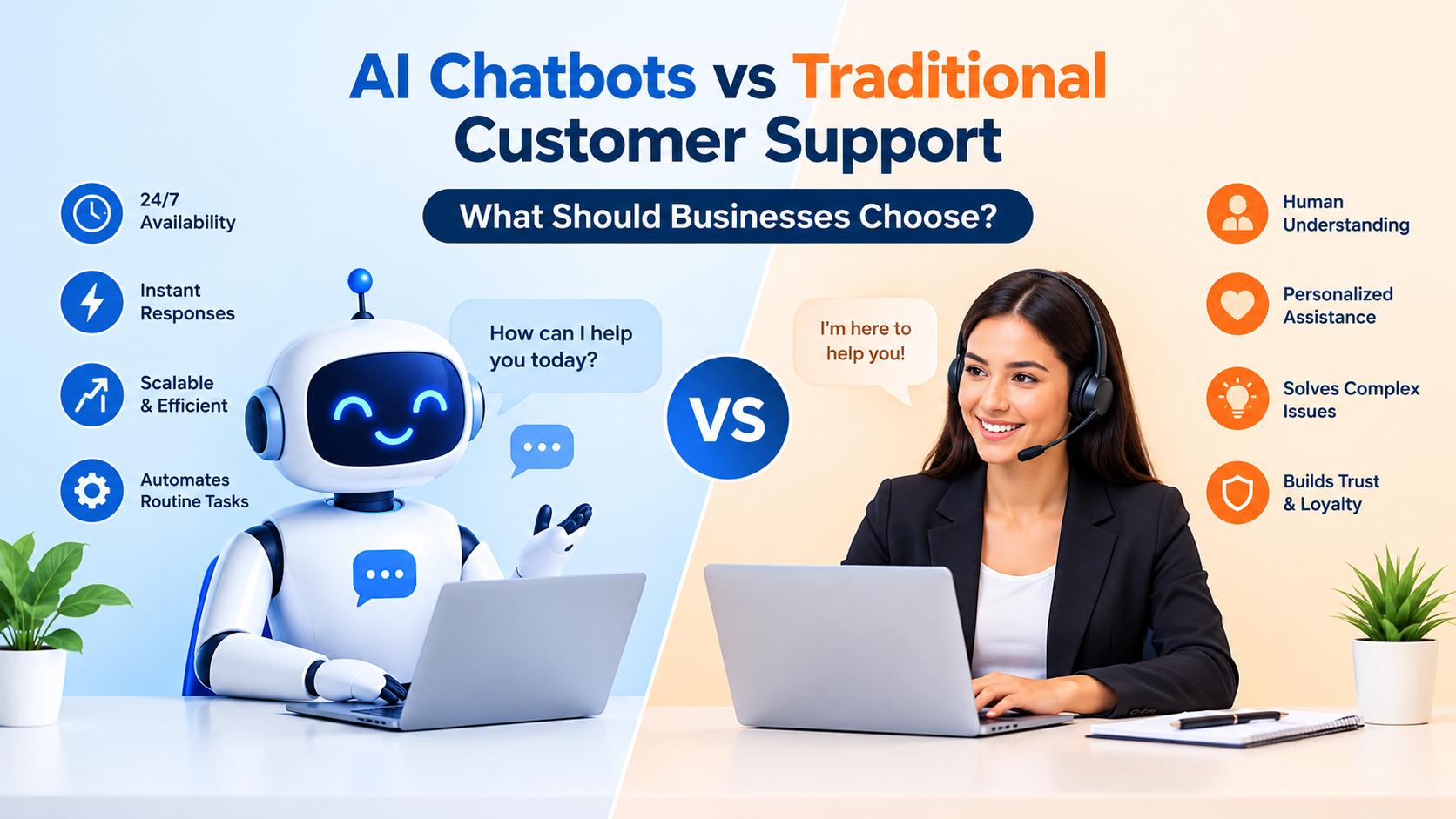
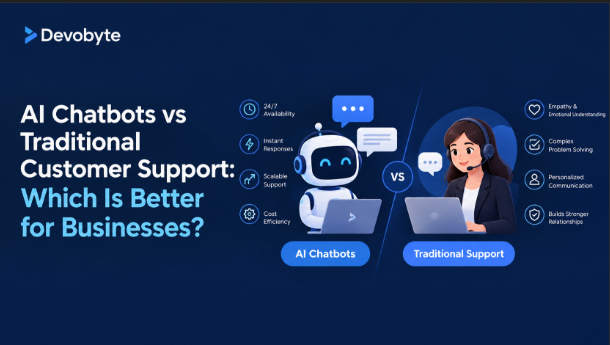
AI chatbots provide speed, scalability, availability, and automation. Traditional customer support provides empathy, flexibility, complex problem-solving, and personalized communication.
For many businesses, a hybrid approach can combine these advantages.
The key is to identify which customer interactions can be automated and which ones require human involvement. Businesses that strategically combine AI technology with skilled customer support teams can create a more efficient and customer-focused support system.
Conclusion
The debate around AI chatbots vs traditional customer support is not necessarily about choosing one technology over another. It is about understanding where automation can create value and where human expertise remains essential.
AI chatbots can help businesses respond faster, manage repetitive questions, provide 24/7 assistance, and scale customer support more efficiently. Human representatives remain important for complex problems, emotional situations, personalized service, and relationship building.
For businesses looking to modernize their customer service, the strongest strategy may be to use AI as an additional support layer rather than treating it as a complete replacement for people.
At Devobyte, we help businesses explore digital solutions that improve efficiency, customer engagement, and online growth. Whether your business needs website development, digital marketing, automation, or technology solutions, choosing the right tools starts with understanding your customers and your business goals.