Customer support has changed significantly as businesses adopt new technologies and customers become more comfortable with digital communication. People expect businesses to respond quickly, provide accurate information, and make it easy to resolve problems. Long waiting times, repetitive questions, and complicated support processes can negatively affect the customer experience. As a result, businesses are increasingly looking at artificial intelligence to improve the way they communicate with customers. This has made the comparison between AI chatbots vs traditional customer support increasingly important for companies planning their customer service strategy.
AI chatbots have become one of the most visible applications of artificial intelligence in customer service. They can communicate with customers through websites, mobile applications, messaging platforms, and other digital channels. Depending on how they are developed and integrated, AI chatbots can answer frequently asked questions, provide product information, help customers navigate websites, collect information, assist with basic troubleshooting, and transfer complex conversations to human representatives.
Traditional customer support relies primarily on human employees who communicate with customers through phone calls, emails, live chat, social media, or support ticket systems. Human representatives can understand complex situations, ask detailed follow-up questions, investigate individual cases, and provide personalized assistance. While traditional customer support remains essential for many businesses, the increasing volume of customer inquiries has encouraged companies to explore automation.
What Are AI Chatbots in Customer Support?
An AI chatbot is a software system that uses artificial intelligence to interact with customers through conversational interfaces. Unlike basic automated systems that depend entirely on predefined commands, modern AI-powered chatbots can process natural-language questions and generate responses based on available information and business rules.
For businesses, an AI chatbot can become an additional layer of customer support. It can provide immediate answers to common questions without requiring a customer service employee to participate in every interaction. For example, an online business could use a chatbot to answer questions about delivery times, return policies, product availability, payment options, or account management.
AI chatbots can also be connected to other business systems. Depending on the implementation, a chatbot may be integrated with a CRM platform, knowledge base, order management system, appointment system, or customer database. These integrations can allow the chatbot to provide more relevant assistance while reducing the amount of manual work required from employees.
What Is Traditional Customer Support?
Traditional customer support refers to support processes where human representatives directly assist customers. This can include telephone support, email support, live chat, help desks, technical support teams, and customer service departments.
Human customer support is particularly valuable when an issue is complicated or requires judgment. A customer may have a unique problem that cannot be solved through a standard response. A human agent can ask additional questions, investigate the situation, review relevant information, and determine an appropriate solution.
Traditional support can also provide a more personal experience. Customers dealing with complaints, complicated billing problems, technical difficulties, or sensitive situations may prefer speaking with a person rather than interacting with an automated system.
AI Chatbots vs Traditional Customer Support: Response Time
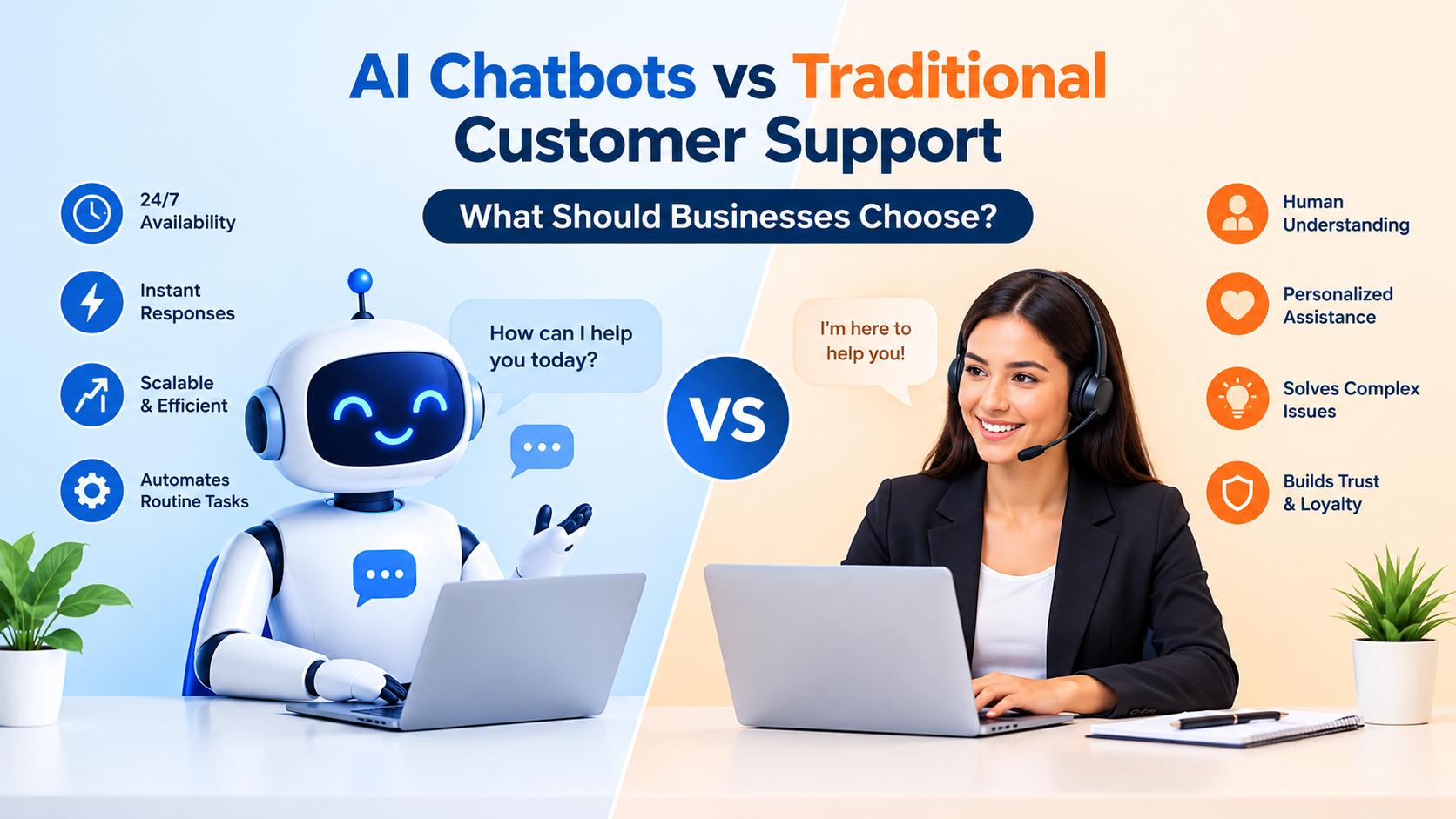
One of the most noticeable differences between AI chatbots and traditional customer support is response time. AI chatbots can respond to customer questions almost immediately. Customers do not have to wait for a support representative to become available before receiving basic information.
This can be particularly useful for businesses that receive a large number of repetitive questions. Instead of requiring customers to submit a ticket and wait for an answer, an AI chatbot can provide relevant information during the first interaction.
Traditional customer support can take longer because human agents have to manage conversations individually. During periods of high demand, customers may have to wait before their questions are answered. Businesses can reduce these delays by increasing staffing levels, but doing so can also increase operating costs.
AI Chatbots vs Traditional Customer Support: Availability
Another important difference is availability. AI chatbots can operate continuously, allowing businesses to provide customer assistance outside traditional working hours. Customers can interact with a chatbot at night, on weekends, or during holidays.
This can be particularly useful for businesses with customers in different countries and time zones. A company does not necessarily need a large team working around the clock to answer basic customer questions.
Traditional customer support is generally limited by employee schedules. Some businesses provide 24/7 support by operating multiple shifts or outsourcing support operations, but this requires additional resources and management.
However, 24/7 chatbot availability does not mean that every customer problem can be solved automatically. When a conversation requires human judgment, the chatbot should provide a clear path for escalation.
AI Chatbots and Customer Support Scalability
Scalability is another area where AI chatbots can provide value. A human support representative can only manage a limited number of conversations at a time. When customer demand increases suddenly, businesses may face longer queues and slower response times.
An AI chatbot can handle many conversations simultaneously. This makes chatbot automation useful for businesses experiencing rapid growth or temporary increases in customer inquiries. For example, an e-commerce company may receive a significant increase in questions during a major sale. A chatbot can handle routine questions about shipping, product availability, and returns while human agents focus on more complicated customer cases.
However, businesses should not assume that every customer interaction can be automated. Scalability works best when the chatbot is used for appropriate tasks and supported by human agents who can handle issues requiring deeper assistance.
How AI Chatbots Reduce Repetitive Customer Support Work
A major reason businesses adopt AI customer support is to reduce repetitive work. Customer service teams frequently receive the same questions from different customers. Employees may spend hours providing information about business hours, product features, shipping policies, account access, payment methods, and returns.
AI chatbots can automate many of these interactions. Once the chatbot has access to reliable business information, it can provide customers with immediate answers to frequently asked questions.
This does not necessarily mean that businesses need fewer customer service employees. Instead, employees can spend less time answering simple questions and more time dealing with complex problems. This can make the overall support operation more efficient.
The Human Advantage in Customer Support
Despite the growth of AI, human customer support continues to have an important role. AI systems can process information quickly, but some customer situations require empathy, judgment, flexibility, and detailed problem-solving.
Consider a customer who has experienced an unusual billing problem. A simple FAQ response may not solve the issue. A human representative can examine the customer's account, understand what happened, communicate with the customer, and determine the appropriate next step.
Human agents are also valuable when customers are frustrated or dealing with sensitive issues. A human representative can adjust their communication based on the situation and provide reassurance while working toward a solution.
For this reason, replacing every human interaction with automation is not necessarily the goal of AI customer support. The more practical objective is often to determine which tasks can be automated and which should remain human-led.
Limitations of AI Chatbots
AI chatbots offer significant advantages, but businesses should also understand their limitations. A chatbot may provide an incorrect or incomplete answer if it does not have access to accurate information. It can also struggle with unusual questions, unclear requests, or problems that require information from multiple business systems.
Another potential issue is customer frustration. If a customer wants to speak to a human but is repeatedly redirected through an automated system, the experience can become frustrating. Businesses should therefore design chatbot experiences with straightforward escalation options.
AI chatbot implementation also requires ongoing monitoring. Businesses need to review chatbot interactions, identify incorrect responses, update information, and improve the system over time. A chatbot should not simply be launched and then ignored.
Traditional Customer Support Has Limitations Too
Traditional customer support also faces several challenges. Human support teams can become overloaded when the number of customer inquiries increases. Long waiting times can lead to frustration, particularly when customers need immediate assistance.
Staffing is another challenge. Businesses need to recruit, train, manage, and retain customer service representatives. Employee turnover can also create additional training requirements.
Repetitive work can affect productivity. When skilled support representatives spend large portions of their working day answering basic questions, less time is available for complex customer issues.
This is where customer support automation can complement traditional support rather than completely replace it.
AI Chatbots for Lead Generation and Sales
AI chatbots can also support businesses beyond customer service. Companies can use conversational AI to engage website visitors and help identify potential customers.
For example, a chatbot can ask visitors what product or service they are interested in, understand their requirements, collect contact information, and direct qualified leads to a sales representative. This can help businesses respond to potential customers more quickly.
AI chatbots can therefore become part of a broader digital sales strategy. Instead of simply answering support questions, they can help businesses capture leads, provide product information, and guide prospects through the early stages of the buying journey.
AI Chatbots and CRM Integration
The value of an AI chatbot can increase when it is connected to a company's existing systems. CRM integration can allow customer interactions to become part of the broader customer relationship management process.
For example, information collected during a chatbot conversation could be recorded in a CRM system. Sales representatives can then use that information when following up with a potential customer.
Integration can also help reduce data entry. Instead of requiring employees to manually transfer information from a chat conversation into another system, relevant information can potentially be captured automatically.
For businesses looking to improve customer support and sales processes, this combination of AI chatbots, CRM systems, and automation can create a more connected workflow.
AI Chatbots and Customer Experience
Customer experience should remain at the center of any chatbot implementation. Businesses should not adopt AI simply because the technology is popular. The chatbot should solve a genuine customer problem.
A good AI chatbot should make it easier for customers to find information, complete tasks, or reach the right support channel. It should not create unnecessary steps.
Businesses should also make it clear when customers are communicating with an AI system. Customers should have an appropriate option to request human assistance when the chatbot cannot resolve their problem.
Data Privacy and Security Considerations
Businesses should also consider privacy and security when implementing AI-powered customer service. Chatbots may process names, email addresses, account information, order details, and other customer data depending on their purpose.
Companies should understand how customer information is collected, stored, processed, and protected. Appropriate access controls and security measures should be implemented based on the type of information being handled.
Businesses should also avoid giving AI systems access to information that is not necessary for their intended purpose. A clear data-handling strategy can help reduce unnecessary risks while allowing the chatbot to provide useful assistance.
When Should a Business Use an AI Chatbot?
AI chatbots can be particularly useful when a business receives a high volume of repetitive customer questions. They can also be useful for companies that need support outside traditional business hours or serve customers across different geographical regions.
Businesses with straightforward customer journeys may also benefit from chatbot automation. For example, companies can use chatbots to answer frequently asked questions, collect basic information, provide product recommendations, or help customers navigate their services.
However, businesses should carefully evaluate whether automation is appropriate for their specific customer interactions. If most customer problems require complex investigation or personal judgment, human support may remain the primary channel.
How Businesses Can Build a Hybrid Customer Support Model
A hybrid customer support model combines AI automation with human expertise. Instead of asking whether businesses should choose chatbots or human representatives, the hybrid approach asks which part of the customer journey is best handled by each.
AI chatbots can manage basic questions and routine tasks. When a customer asks a complicated question or needs personalized assistance, the chatbot can collect relevant information and transfer the conversation to a human agent.
This approach allows businesses to maintain the speed and scalability of AI while preserving human involvement for situations where it is most valuable.
How to Implement AI Chatbots Successfully
Businesses should begin with a clear understanding of their existing customer support process. They should identify common customer questions, repetitive tasks, frequently reported problems, and areas where customers currently experience delays.
The next step is to determine which interactions are suitable for automation. Simple, repetitive, and information-based questions are often good candidates. Complex problems requiring investigation or decision-making can remain with human representatives.
Businesses should then choose an AI chatbot solution that can integrate with their existing technology. Depending on the organization, this could include CRM software, help desk systems, websites, knowledge bases, communication platforms, and other business applications.
Testing is another important stage. Before launching a chatbot to all customers, businesses should test it using realistic customer questions. They should evaluate whether the chatbot provides accurate answers and whether it knows when to transfer conversations to human agents.
After launch, businesses should monitor chatbot performance continuously. Customer feedback, unresolved questions, escalation rates, and chatbot interactions can provide valuable information for improving the system.
The Future of AI Customer Support
AI is likely to continue influencing customer service as businesses discover new ways to automate repetitive processes and improve customer interactions. Future customer support systems may combine conversational AI, CRM data, automation, analytics, and human assistance into a single workflow.
However, the growth of AI does not necessarily mean the end of human customer support. Instead, businesses may increasingly use AI to assist employees and handle routine interactions while human representatives focus on complex and high-value customer needs.
The most successful implementations are likely to be those that treat AI as part of a broader customer experience strategy rather than as a standalone technology.
Conclusion
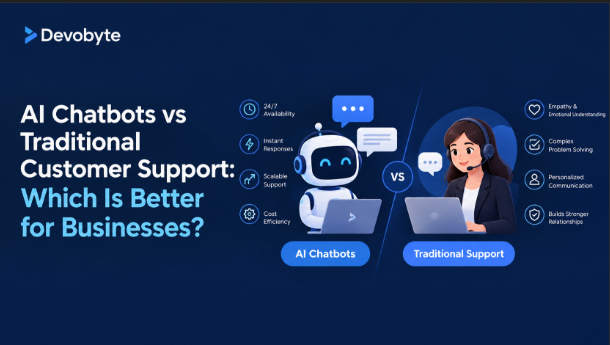
The comparison between AI chatbots vs traditional customer support is ultimately about understanding the strengths and limitations of both approaches. AI chatbots can provide fast responses, 24/7 availability, scalability, and automation for repetitive tasks. Traditional customer support provides human judgment, empathy, personalized communication, and complex problem-solving.
For many businesses, the most practical approach is not to choose one over the other. Instead, businesses can combine AI-powered customer service with human support to create a hybrid model. Chatbots can handle routine questions and assist customers at the first point of contact, while human representatives can step in when a situation requires deeper understanding or personalized assistance.
As businesses continue adopting artificial intelligence, customer support strategies will need to focus on more than automation. Companies need to consider customer expectations, data security, system integration, response quality, and the overall customer journey. When implemented thoughtfully, AI chatbots can reduce repetitive workloads, improve response times, and help customer support teams focus their attention where human expertise matters most.
To read more such news kindly visit: Devobyte