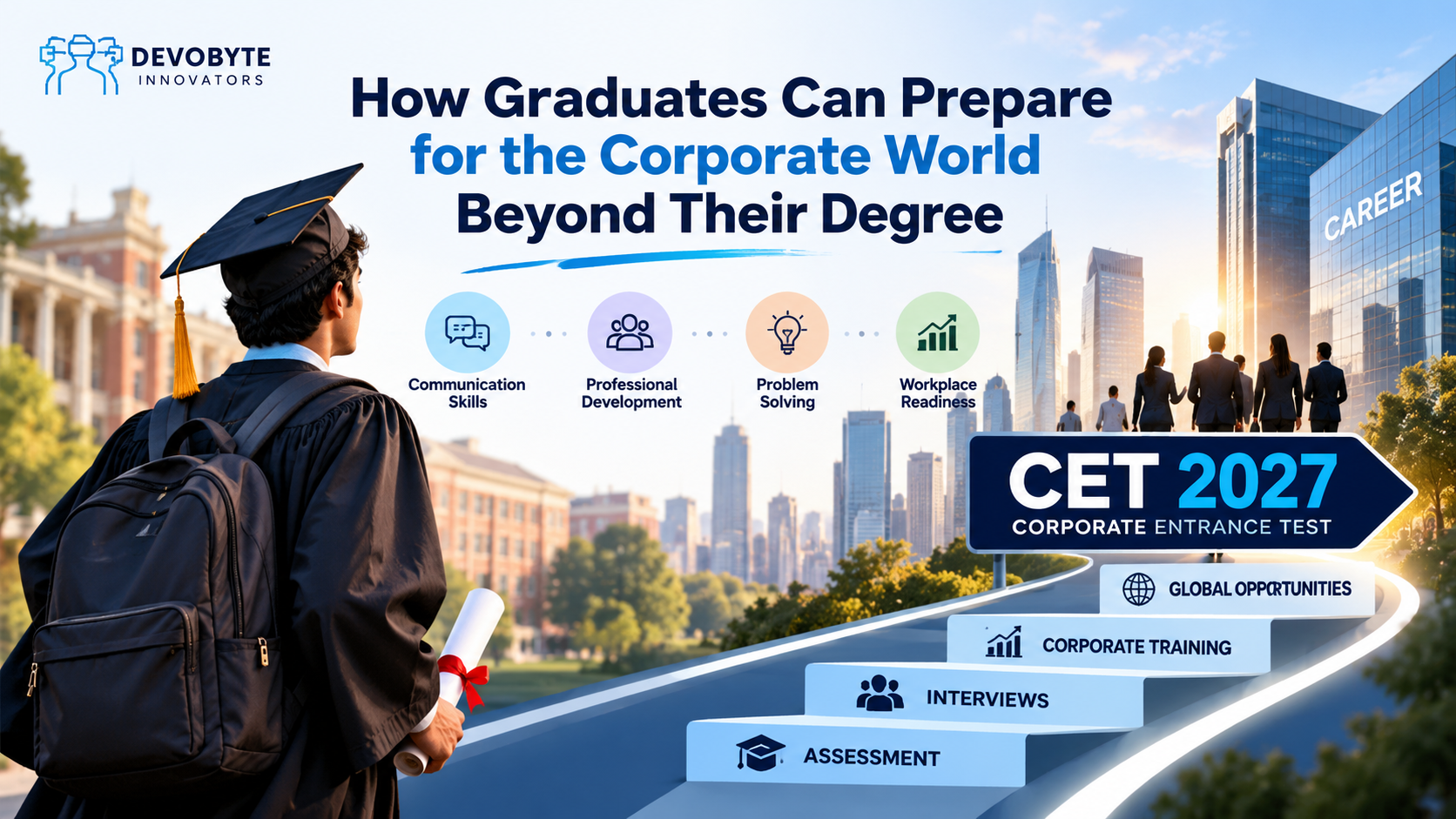
Graduating with a degree is an important milestone, but it is rarely the end of the learning journey. For many students, the next challenge is understanding how to move from an academic environment into a professional one. A degree can demonstrate subject knowledge, but the workplace often requires a broader set of skills, including communication, problem-solving, professional behaviour, digital skills and the ability to make decisions in real-world situations.
This transition can sometimes feel difficult because college and the workplace operate differently. Students may spend years preparing for examinations and completing academic projects, but professional environments introduce new expectations. Meetings, presentations, teamwork, deadlines, client communication and workplace decision-making become part of everyday responsibilities. Preparing for these expectations before entering the workforce can help graduates approach their first professional opportunities with greater awareness.
A Degree Is the Starting Point, Not the Finish Line
Academic qualifications remain an important part of building a career. They provide foundational knowledge and demonstrate that a student has completed a particular course of study. However, professional life often requires people to apply that knowledge in practical situations.
For example, someone may understand a technical concept but still need to explain it clearly to a non-technical colleague or client. A graduate may have strong academic knowledge but also need to collaborate with a team, manage priorities and communicate professionally. These abilities are developed through practice and exposure, not simply through academic examinations.
This is where the idea of corporate readiness becomes important. Being corporate-ready is not about knowing everything before getting your first job. It is about developing the communication, professional, analytical and practical skills needed to adapt to a workplace.
What Skills Should Graduates Develop?
There is no single formula for becoming workplace-ready. Different industries and roles have different expectations, but several skills are useful across professional environments.
Communication and Business Writing
Communication is one of the most important skills graduates can develop. In a workplace, communication can take many forms, including emails, presentations, meetings, reports, interviews and conversations with colleagues or clients.
Being able to communicate clearly means understanding not only what to say, but also how to say it depending on the situation. Graduates can start developing this skill by practising professional emails, presentations, group discussions and short explanations of complex ideas.
Problem-Solving and Logical Thinking
Professional environments regularly involve problems that do not have straightforward answers. Employees may need to analyse information, identify possible solutions and decide what approach makes the most sense.
Developing logical and analytical thinking can therefore be valuable across fields. Graduates can improve these skills by working through reasoning problems, case studies, business situations and practical projects rather than relying only on memorisation.
Workplace Judgment
The workplace also involves situations where there may not be one obvious answer. How should an employee respond to a difficult client? What should someone do when two deadlines conflict? When should an issue be escalated to a manager?
These situations require judgment, awareness and an understanding of professional behaviour. Learning to think through workplace scenarios can help students understand the difference between simply completing a task and making a professional decision.
Digital and Business Skills
Technology has become part of almost every professional environment. Depending on the role, graduates may work with spreadsheets, presentations, collaboration platforms, communication tools, analytics software, CRM systems or specialised applications.
Building familiarity with commonly used digital and business tools can make the transition from college to the workplace easier. The goal is not necessarily to master every tool, but to develop the ability to learn and adapt to the tools a particular role requires.
How Can Graduates Build Corporate Readiness?
Corporate readiness develops gradually. Students do not need to wait until graduation to start preparing for professional life.
One useful approach is to combine academic learning with practical experiences. Internships, projects, presentations, competitions, volunteering, part-time work and collaborative activities can all provide opportunities to practise professional skills.
Students can also work on their resumes and professional profiles before they begin actively searching for jobs. A clear resume should communicate what a candidate has learned, what they have worked on and what they can contribute. Similarly, a professional online presence can help graduates present their skills and projects more effectively.
Interview preparation is another important part of the process. Instead of preparing only for common questions such as “Tell me about yourself,” students can practise explaining projects, discussing challenges they have faced and responding to situational questions.
Where Does CET 2027 Fit Into This Journey?
For students and recent graduates looking for a structured way to assess their corporate readiness, CET 2027, or the Corporate Entrance Test, provides a national-level assessment focused on areas relevant to the transition from education to professional life.
The assessment covers more than traditional academic subjects. Its written examination includes Quantitative & Logical Reasoning, Verbal & Communication Ability, Workplace Judgment & Situational Reasoning, and General Business & Corporate Awareness.
The online examination consists of 80 questions, with 20 questions in each section, and candidates have one hour to complete it. Correct answers carry one mark, while incorrect answers carry a negative marking of one-third of a mark.
This combination is designed to look at different aspects of a candidate's readiness rather than focusing on a single academic discipline.
What Happens After the CET 2027 Exam?
The CET journey continues beyond the written assessment. Candidates receive a national rank and percentile, along with a personalised Corporate Readiness Report and digital Rank Card.
Virtual interviews are scheduled for March 1 to March 31, 2027. The final shortlist of 1,000 candidates is scheduled to be announced on April 15, 2027.
The final selection uses a combination of written examination and interview performance. The written examination contributes 60%, while the virtual interview contributes 40%.
This structure gives candidates an opportunity to demonstrate both their assessment performance and their ability to communicate and respond during an interview.
Building Professional Skills Through the Corporate Launch Program
For the selected 1,000 candidates, the next stage is the Corporate Launch Program, scheduled from June 1 to August 31, 2027.
The three-month program focuses on practical areas that can help participants understand professional expectations. These include professional communication and business writing, resume building and personal branding, corporate etiquette and workplace behaviour, digital and business tools, sales and negotiation, client communication, interview preparation and group discussion practice.
The program also introduces domain foundations across areas such as IT and Consulting, BFSI, Marketing and Operations. Participants can work through live projects and case studies and complete a capstone evaluation.
The program format includes live and recorded sessions, mentor office hours and one-to-one guidance. Employer assessment is also part of the broader program structure, giving participants exposure to evaluation beyond a traditional examination setting.
Learning From Practical Experiences
One of the most useful ways to prepare for professional life is to understand how knowledge is applied outside the classroom.
Case studies and live projects can help graduates think about problems from a business perspective. Instead of simply looking for the correct theoretical answer, participants may need to understand the problem, evaluate different options and communicate their reasoning.
Similarly, working on communication, presentations and group discussions can help students become more comfortable expressing ideas in professional situations.
These experiences are particularly useful because professional growth does not stop when someone receives their first job offer. The ability to learn, adapt and communicate continues to matter throughout a career.
The Importance of Building a Professional Identity
Preparing for the corporate world also means understanding how to present yourself professionally.
A resume should be more than a list of qualifications. It should give employers a clear picture of a candidate's skills, projects, experiences and areas of interest. Personal branding can also involve maintaining a professional LinkedIn profile, showcasing relevant projects and communicating career interests clearly.
For students with limited work experience, academic projects, internships, certifications, competitions and independent work can help demonstrate practical abilities. What matters is being able to explain what was done, what was learned and how it contributed to a particular outcome.
CET 2027 and the Dubai Global Experience
The CET journey also includes a later global exposure opportunity. The top 20 performers of the Corporate Launch Program are scheduled to receive a fully sponsored five-night, six-day Dubai Global Experience.
The experience is designed around corporate immersion and includes corporate visits, interactive workshops, opportunities to meet global leaders, cultural experiences and international networking.
Importantly, this opportunity is connected to performance during the Corporate Launch Program rather than being determined solely by the written CET examination. The Top 20 announcement is scheduled for September 1, 2027.
This makes the overall journey broader than a single test. The assessment is an entry point into a longer process involving interviews, training, professional development and program performance.
Important CET 2027 Dates
For students considering the assessment, keeping track of the application and program timeline is important. Applications are scheduled to open on October 1, 2026, and close on December 31, 2026. The admit card is scheduled for January 15, 2027, followed by the online written examination on January 31, 2027.
Virtual interviews are scheduled throughout March, with the final shortlist of 1,000 announced on April 15. The Corporate Launch Program then runs from June 1 to August 31, followed by the announcement of the top 20 performers on September 1, 2027.
The application fee for CET 2027 is ₹250.
Preparing for the Corporate World Is a Continuous Process
There is no single examination, certification or course that can completely prepare someone for a career. Professional readiness develops through a combination of knowledge, practice, experience and continuous learning.
For students, the process can begin well before graduation. Building communication skills, working on practical projects, learning digital tools, developing professional habits and becoming comfortable with interviews can all contribute to a smoother transition into the workplace.
CET 2027 is one structured approach to this transition, combining assessment with interviews, corporate training, practical learning and employer evaluation. For final-year students and recent graduates, it provides an opportunity to assess where they currently stand while gaining exposure to skills that are relevant to professional environments.
The goal after graduation should not simply be to have a degree. It should be to understand how to apply what you have learned, communicate your value and continue developing as the workplace changes. A degree can open the door, but the skills you build beyond it can shape how prepared you are to step through that door.