B2B lead generation has changed significantly in recent years. Businesses can no longer depend only on traditional sales calls, generic email campaigns, or broad advertising to find potential customers. Today, companies use multiple digital channels to identify decision-makers, start conversations, build relationships, and convert prospects into customers.
Two of the most widely used approaches are LinkedIn outreach and cold email.
Both can help businesses connect with potential customers, but they work differently. LinkedIn provides a professional environment where businesses can identify people based on their roles, industries, companies, and interests. Cold email, on the other hand, allows businesses to communicate directly with prospects through personalized email campaigns.
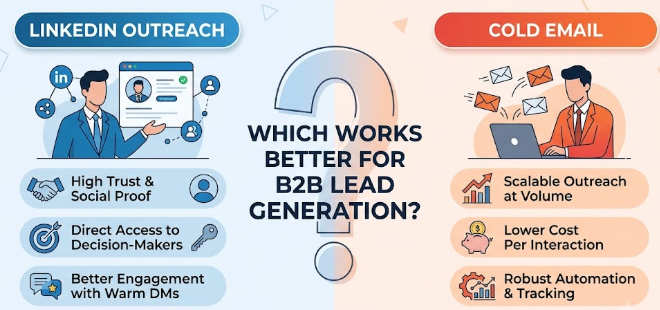
So, when comparing LinkedIn outreach vs cold email, which one works better for B2B lead generation?
The answer depends on your target audience, offer, sales cycle, personalization strategy, and goals. Instead of treating them as competing channels, many B2B companies can use both together as part of a broader lead-generation strategy.
What Is LinkedIn Outreach?
LinkedIn outreach is the process of finding and contacting potential customers through LinkedIn.
Businesses can search for prospects based on factors such as:
- Job title
- Industry
- Company size
- Location
- Seniority
- Company
- Skills and professional interests
For example, a SaaS company selling CRM software may search for sales managers, business development heads, founders, or revenue leaders at growing companies.
The objective isn't simply to send hundreds of connection requests. Effective LinkedIn outreach focuses on relevant prospects, personalized messaging, and relationship building.
A typical LinkedIn outreach process may look like:
- Identify the ideal customer profile.
- Find relevant decision-makers.
- Review their professional background.
- Send a personalized connection request.
- Start a relevant conversation.
- Understand their business needs.
- Introduce the solution when appropriate.
- Move qualified prospects toward a sales call or demonstration.
This makes LinkedIn particularly useful for businesses that sell professional services, SaaS products, consulting, technology solutions, and other B2B offerings.
What Is Cold Email?
Cold email is the practice of sending a business email to a potential customer who has not previously interacted with the company.
Unlike an email sent to an existing subscriber or customer, a cold email starts a conversation with a new prospect.
For example, a digital marketing agency may identify growing D2C brands and contact their marketing managers with a personalized message explaining how the agency could help improve their organic traffic or paid campaigns.
A cold email usually includes:
- A relevant subject line
- Personalized opening
- A specific problem or opportunity
- A concise explanation of the solution
- A clear call to action
The quality of a cold email campaign depends heavily on targeting and personalization. Sending the same generic message to thousands of companies may produce poor results.
Neither channel automatically guarantees more leads. The results depend on how well the campaign is planned and executed.
Advantages of LinkedIn Outreach for B2B Lead Generation
1. Easy Access to Decision-Makers
LinkedIn is built around professional identities. This makes it easier to identify people according to their job titles, companies, and responsibilities.
Instead of contacting a general company inbox, sales teams can potentially reach the person responsible for a specific business function.
For example, a CRM company may target:
- Sales Directors
- Business Development Managers
- Founders
- Revenue Leaders
- Sales Operations Managers
This can improve the relevance of outreach.
2. Stronger Context for Personalization
LinkedIn profiles provide useful information about prospects.
A salesperson can look at someone's:
- Current role
- Previous experience
- Recent posts
- Company
- Industry
- Professional interests
This information can be used to create more relevant messages.
Instead of saying:
"We provide the best CRM solutions for businesses."
A personalized message could reference a company's recent expansion, sales hiring, or operational challenge.
3. Relationship Building
B2B purchases often involve trust and multiple interactions.
LinkedIn allows businesses to engage with prospects before making a direct sales pitch. A company can comment on posts, share useful content, and gradually build familiarity.
This can be especially valuable when selling high-value or complex B2B solutions.
4. Useful for Personal Branding
LinkedIn outreach can work alongside content marketing.
Salespeople and founders can publish educational content, case studies, industry insights, and opinions. When prospects visit their profile after receiving a message, strong content can reinforce credibility.
Limitations of LinkedIn Outreach
LinkedIn outreach also has limitations.
Sending highly personalized messages takes time. There are also platform restrictions around connection requests and messaging. Poorly targeted outreach can result in ignored messages or connection requests.
Another common problem is excessive pitching.
If the first message immediately asks for a meeting without establishing relevance, prospects may simply ignore it.
Therefore, LinkedIn outreach should focus on quality over quantity.
Advantages of Cold Email for B2B Lead Generation
1. Highly Scalable
One of the biggest advantages of cold email is scalability.
Once a business has a defined ideal customer profile and a reliable prospect database, it can create structured email sequences for different audience segments.
For example, separate campaigns can be created for:
- SaaS companies
- E-commerce brands
- Financial companies
- Healthcare businesses
- Startups
- Agencies
Each campaign can have messaging relevant to the industry's needs.
2. Direct Communication
Email gives businesses direct access to a prospect's inbox.
A prospect does not need to accept a connection request before receiving the message. This can make email useful for reaching specific decision-makers.
3. Automated Follow-Ups
Cold email campaigns can include multiple follow-ups.
For example:
Email 1: Introduction and relevant problem
Email 2: Additional value or insight
Email 3: Case study or example
Email 4: Final follow-up
This allows sales teams to maintain consistent communication without manually sending every message.
4. Easier Campaign Tracking
Email campaigns can be monitored using metrics such as:
- Delivery rate
- Open rate
- Click-through rate
- Reply rate
- Positive reply rate
- Meetings booked
- Conversion rate
These metrics help marketers understand which messaging and audience segments are performing better.
Limitations of Cold Email
Cold email has its own challenges.
The biggest concern is email deliverability. Poor-quality lists, irrelevant messaging, excessive sending, or improper email practices can negatively affect campaign performance.
Another challenge is competition.
Business professionals receive a large number of emails every day. A generic subject line and lengthy sales pitch may be ignored.
That is why modern cold email campaigns need:
- Accurate prospect data
- Strong segmentation
- Relevant messaging
- Personalization
- Clear CTAs
- Responsible sending practices
- Consistent testing
LinkedIn Outreach vs Cold Email: Which Is More Effective?
There isn't one universal winner.
The effectiveness of LinkedIn outreach vs cold email depends on several factors.
Choose LinkedIn Outreach When:
LinkedIn may be particularly useful when:
- Your audience is active on LinkedIn.
- You sell high-value B2B services.
- Relationship building is important.
- Your sales process requires trust.
- Your prospects are easy to identify by job title.
- Personal branding is part of your strategy.
For example, a B2B consulting company may benefit from LinkedIn because prospects can evaluate the consultant's profile, experience, content, and professional network.
Choose Cold Email When:
Cold email may be more suitable when:
- You need to reach a large prospect database.
- Your ICP is clearly defined.
- You have accurate business contact information.
- Your sales process can be structured into sequences.
- You want measurable outbound campaigns.
- You need systematic follow-ups.
For example, a software company targeting thousands of businesses across multiple regions may use segmented email campaigns to reach relevant decision-makers.
Why Combining LinkedIn and Cold Email Can Work
Instead of asking whether LinkedIn outreach or cold email is better, businesses can use both channels together.
This approach is often called multichannel B2B outreach.
For example:
Step 1: Research the Prospect
Identify a company that matches your ideal customer profile.
Step 2: Find the Decision-Maker
Identify the relevant person based on their role and responsibilities.
Step 3: Engage on LinkedIn
Follow their profile or engage with relevant content before sending a direct message.
Step 4: Send a Personalized Email
Use the research gathered to create a relevant email addressing a specific business problem.
Step 5: Follow Up on LinkedIn
If appropriate, continue the conversation on LinkedIn rather than repeatedly sending the same email.
Step 6: Provide Value
Share a useful resource, insight, case study, audit, or recommendation instead of repeatedly asking for a meeting.
Step 7: Qualify the Lead
Once the prospect responds positively, understand their requirements, budget, timeline, and decision-making process.
This creates multiple touchpoints without relying entirely on one platform.
How to Improve Your B2B Lead Generation Strategy
Regardless of the channel you choose, several fundamentals can improve your results.
Define Your Ideal Customer Profile
Before starting outreach, determine exactly who you want to reach.
Consider:
- Industry
- Company size
- Location
- Revenue range
- Job title
- Business problem
- Buying intent
A clearly defined ICP helps reduce irrelevant outreach.
Personalize Your Messages
Personalization should go beyond inserting someone's first name.
Reference something genuinely relevant to the prospect, such as:
- A recent company development
- Their role
- A business challenge
- An industry trend
- A recent product launch
- A relevant business opportunity
The goal is to demonstrate why you contacted that particular prospect.
Keep Messages Concise
B2B decision-makers are busy.
Avoid long introductions and excessive company information. Explain the problem, provide relevant value, and make the next step simple.
Focus on the Prospect
A common mistake is spending most of the message describing your company.
Instead of:
"We are a leading digital marketing company offering SEO, social media, web development, PPC, and content marketing."
Focus on the prospect's potential challenge and how your service can address it.
Test Different Approaches
There is no single outreach message that works for every audience.
Test:
- Subject lines
- Opening sentences
- CTAs
- Message length
- Personalization
- Target industries
- Job titles
- Follow-up timing
Then measure the results.
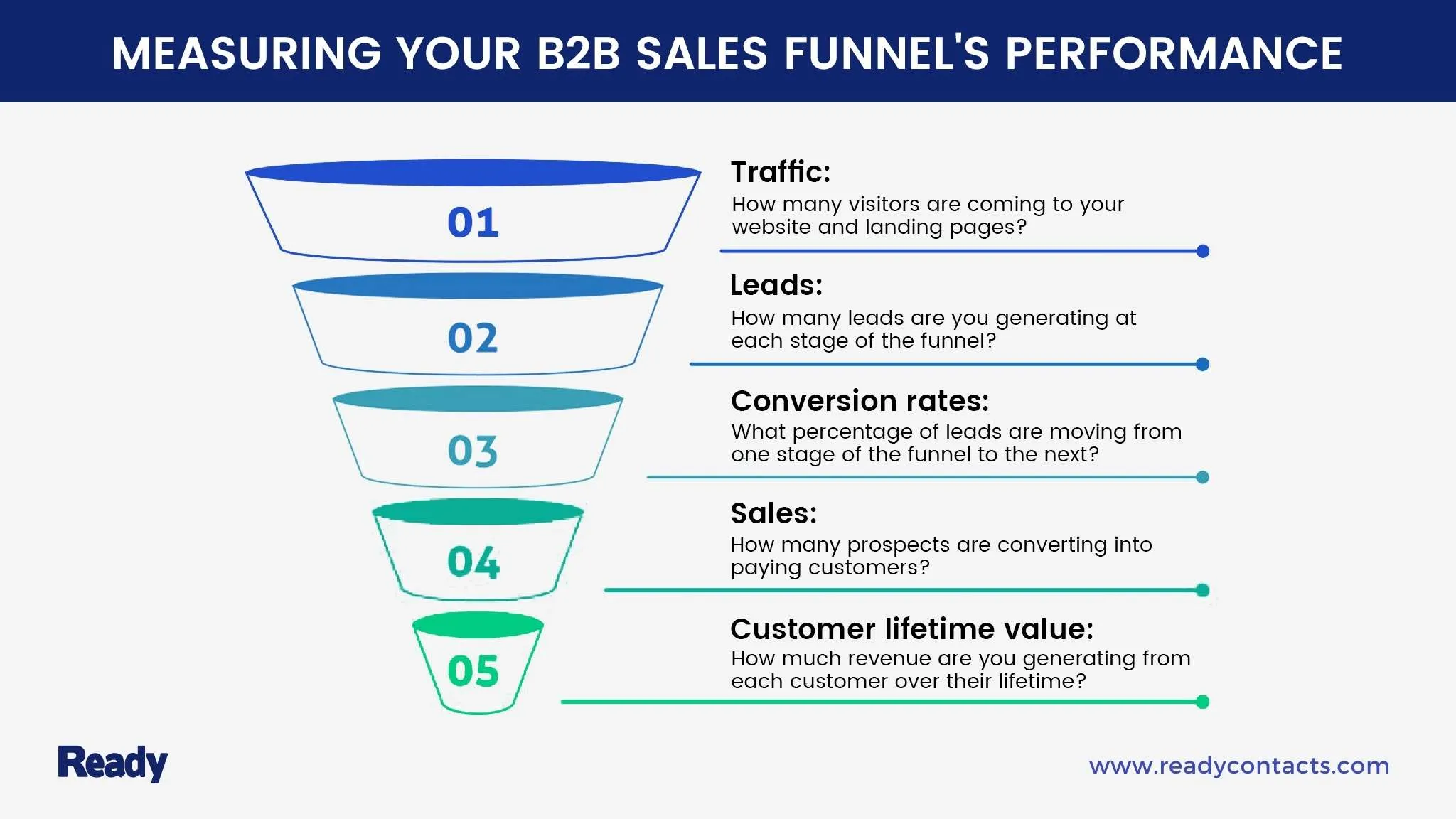
Important B2B Outreach Metrics to Track
Tracking the right metrics helps businesses understand whether their outreach is actually generating qualified opportunities.
Important metrics include:
Response Rate: Percentage of prospects who respond.
Positive Response Rate: Percentage of prospects who show genuine interest.
Meeting Booking Rate: Percentage of contacted prospects who schedule a meeting.
Lead-to-Customer Conversion Rate: Percentage of generated leads that become customers.
Cost per Lead: Total campaign cost divided by the number of leads generated.
Customer Acquisition Cost (CAC): Total sales and marketing costs required to acquire a customer.
Don't focus only on the number of messages sent. A campaign that generates fewer but highly qualified leads may be more useful than one producing a large number of irrelevant responses.
Final Verdict: LinkedIn Outreach or Cold Email?
When comparing LinkedIn outreach vs cold email, businesses should not view the decision as an either-or choice.
LinkedIn can provide strong opportunities for professional networking, personalization, relationship building, and personal branding. Cold email can provide direct communication, scalability, structured follow-ups, and measurable campaigns.
For many B2B businesses, the more practical approach is to combine both channels.
Start with a clearly defined ideal customer profile. Research the right prospects, personalize your communication, provide genuine value, and continuously measure campaign performance.
The goal of B2B lead generation isn't simply to send more messages. It is to start meaningful conversations with the right people and turn relevant conversations into qualified business opportunities.
With a strategic combination of LinkedIn outreach, cold email, content marketing, SEO, and other digital marketing channels, businesses can build a more consistent and sustainable B2B lead-generation system.
Frequently Asked Questions
1. Is LinkedIn outreach better than cold email for B2B?
Neither channel is universally better. LinkedIn can be useful for relationship-driven outreach, while cold email can be effective for scalable and structured campaigns.
2. Can LinkedIn and cold email be used together?
Yes. Businesses can use both channels as part of a multichannel B2B outreach strategy.
3. How often should businesses follow up with prospects?
Follow-up frequency depends on the audience, sales cycle, and channel. Businesses should prioritize relevant communication rather than sending repetitive messages.
4. What is the most important factor in B2B outreach?
Accurate targeting and relevance are among the most important factors. A well-personalized message sent to the wrong audience will still produce poor results.
5. How can businesses improve B2B lead generation?
Define a clear ICP, research prospects carefully, personalize outreach, create valuable content, use multiple channels, and track conversion metrics rather than focusing only on outreach volume.