
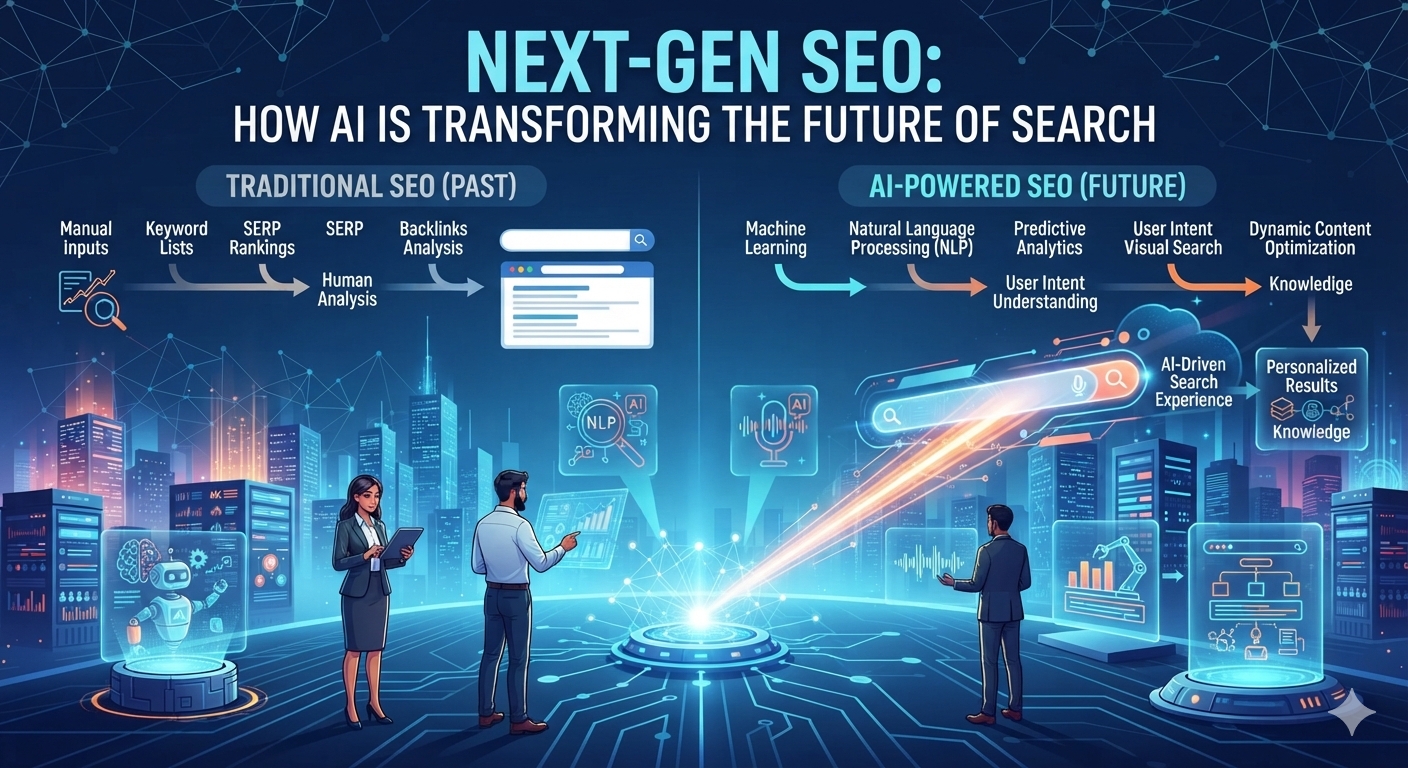
Next-Gen SEO: How AI and Emerging Technologies Are Transforming Search
Search engine optimization is going through one of its biggest transformations yet. For years, businesses relied on keywords, backlinks, technical optimization, and Google rankings to attract organic traffic. While these fundamentals remain important, the way people discover information online is changing rapidly. Artificial intelligence, conversational search, voice search, visual discovery, and personalized search experiences are reshaping the digital landscape. This evolution has created a new approach known as next-gen SEO, which focuses on helping businesses remain visible across the changing world of search.
For businesses, next-gen SEO is no longer simply about ranking a webpage for a particular keyword. It is about understanding what customers are looking for, creating genuinely useful content, building topical authority, improving website performance, and making information accessible to both traditional search engines and AI-powered search systems. Companies that adapt their SEO strategies to these changes can create stronger opportunities for organic visibility and long-term digital growth.
What Is Next-Gen SEO?
Next-gen SEO is the evolution of traditional search engine optimization for a more intelligent and increasingly AI-driven search environment. Traditional SEO often concentrated on keyword targeting, backlinks, metadata, and technical factors. Next-gen SEO combines these foundations with search intent, semantic relevance, artificial intelligence, structured information, first-hand expertise, user experience, and multi-platform discovery.
The fundamental objective remains the same: helping people discover relevant information. However, the methods used to achieve that objective are becoming more sophisticated. Search engines and AI systems can now interpret context, understand relationships between concepts, process natural language, and identify information that may be useful to a specific query.
For businesses, this means SEO strategies need to move beyond simply asking, "Which keyword should we rank for?" The more important question is, "What information does our audience need, and how can our website provide the most useful answer?"
Why Businesses Need a Next-Gen SEO Strategy
Search behavior is no longer limited to traditional search engines. Users can discover information through AI assistants, social platforms, video content, maps, voice search, and other digital channels. This creates a more complex search ecosystem where businesses need to maintain visibility across multiple discovery points.
For example, a customer looking for a web development company might search Google, ask an AI platform for recommendations, watch a YouTube video about website development, or discover a development agency through social media. Each of these interactions represents a different search experience.
A modern SEO strategy for businesses therefore needs to account for how customers discover, evaluate, and interact with information across different platforms. Next-gen SEO provides a framework for doing this while maintaining the core principles of relevance, usefulness, technical quality, and trust.
AI Is Transforming Search
Artificial intelligence is one of the most important developments influencing the future of SEO. AI-powered search systems can interpret complex questions, understand conversational language, summarize information, and connect concepts from multiple sources. This is changing the traditional relationship between a user and a search engine.
Instead of entering several short keywords, users can now ask detailed questions. They may expect a direct explanation rather than a simple list of links. This creates both challenges and opportunities for businesses.
Companies that publish clear, authoritative, well-structured content can improve their chances of being understood and discovered within these evolving search experiences. This does not mean businesses should write content specifically for machines. Instead, they should focus on producing genuinely useful information that is easy for both humans and search systems to understand.
Search Intent Is More Important Than Keyword Density
One of the biggest changes in modern SEO is the growing importance of search intent. Search intent refers to the underlying reason behind a user's search.
For example, someone searching for "website development" could be looking for a development company, researching how websites are created, comparing development costs, or learning about different technologies. Simply using the keyword repeatedly does not address all these possible needs.
Next-gen SEO focuses on understanding the context behind searches and creating content that satisfies the user's purpose. Businesses should answer important questions, explain concepts clearly, address potential concerns, and provide useful next steps.
This creates a better experience for users and helps search systems understand what a webpage is actually about.
Semantic SEO and Topic-Based Content
Another important element of next-gen SEO is semantic SEO. Rather than treating keywords as isolated phrases, semantic SEO focuses on relationships between topics, concepts, entities, and user questions.
For example, a business publishing content about website development could also cover website performance, responsive design, UX, cybersecurity, conversion optimization, content management systems, hosting, maintenance, and technical SEO.
Creating interconnected content around these related subjects can help establish topical depth. Internal links can connect relevant pages and help users move from one topic to another while giving search engines additional context about the website.
This approach is particularly valuable for businesses that want to establish authority within a competitive industry.
Building Topical Authority
Search visibility increasingly depends on the overall quality and relevance of a website's content ecosystem. Publishing one article about a subject is unlikely to demonstrate comprehensive expertise. Businesses can instead develop clusters of content covering different aspects of a particular topic.
For example, a technology company could build a content cluster around digital transformation. One article could explain digital transformation for small businesses, while additional articles could discuss cloud migration, AI implementation, business automation, cybersecurity, data management, and customer experience.
When these resources are connected logically, they create a stronger information structure. This can help businesses demonstrate depth while giving visitors more opportunities to find relevant answers.
Original Content Will Become More Valuable
The rapid growth of AI-generated content has made the internet increasingly crowded with similar information. As a result, simply producing more articles is not necessarily the best way to improve SEO.
Businesses can stand out by incorporating original insights and first-hand experience into their content. Case studies, customer experiences, original research, project findings, expert commentary, statistics, and real-world examples can make a page more useful and distinctive.
For example, instead of publishing a generic article about website speed, a development company could explain common performance problems it has encountered, how those problems were identified, and what types of solutions were implemented.
This type of content provides practical value that generic information often cannot deliver.
Technical SEO Remains a Foundation
While the future of search is changing, technical SEO remains essential. Even the most useful content can struggle to perform if a website has serious technical problems.
Businesses should ensure that their websites are easy for search engines to crawl and index. Website speed, mobile responsiveness, HTTPS security, internal linking, redirects, canonicalization, XML sitemaps, structured data, and Core Web Vitals should all form part of an ongoing technical SEO strategy.
Technical optimization also directly affects the user experience. A fast, responsive, secure website makes it easier for visitors to consume content and interact with a business.
Website Performance and Next-Gen SEO
Website performance has become an important part of creating a successful digital experience. Users expect websites to load quickly and function smoothly across devices.
A slow website can create friction before visitors even see the content. Poor mobile performance can be especially problematic because a significant amount of online browsing takes place on smartphones.
Businesses should therefore treat website performance as more than a technical requirement. It should be considered part of the overall SEO and conversion strategy. Improving loading speed, optimizing images, reducing unnecessary scripts, improving server performance, and maintaining a responsive design can contribute to a stronger digital experience.
Conversational Search Is Changing Content Creation
The way people formulate search queries is becoming increasingly conversational. Voice assistants and AI-powered platforms allow users to ask questions naturally rather than relying on short keyword phrases.
This means businesses should consider the questions their customers are likely to ask and provide direct answers within their content. Question-based headings, explanatory paragraphs, FAQs, and conversational language can make content more accessible.
Instead of creating content around a phrase such as "AI chatbot customer support," for example, a business could address questions such as how AI chatbots work, how they can reduce customer support workloads, what businesses should consider before implementing them, and how they can be integrated into existing systems.
Voice Search and Local Discovery
Voice search is another area businesses should consider when developing a next-gen SEO strategy. Users often phrase voice searches as complete questions, particularly when looking for nearby businesses, services, directions, or quick answers.
For local businesses, accurate business information is especially important. Consistent business details, relevant location-based content, useful service information, and a well-optimized website can help businesses improve their overall local search presence.
The broader principle is simple: businesses should make it easy for customers to understand what they offer, where they operate, and how they can be contacted.
Visual Search and Multimedia SEO
Modern search is increasingly visual. Images, videos, infographics, screenshots, and other forms of multimedia can provide additional ways for audiences to discover a business.
Businesses should therefore optimize visual assets as part of their SEO strategy. Descriptive filenames, relevant alt text, useful captions, and appropriate surrounding content can provide additional context for images.
Video content can also support SEO by answering customer questions, demonstrating products or services, explaining complex topics, and creating opportunities for discovery on video platforms.
User Experience Is Part of Modern SEO
SEO should not end when a visitor clicks on a search result. The experience that follows is equally important.
A website may attract organic traffic, but if visitors encounter confusing navigation, slow loading speeds, intrusive pop-ups, unclear messaging, or difficult forms, they may leave without taking any action.
Next-gen SEO therefore considers the entire user journey. Content should be easy to read, navigation should be intuitive, important information should be easy to find, and calls to action should be relevant to the visitor's needs.
A strong combination of SEO and user experience can help businesses turn search visibility into meaningful engagement.
How AI Tools Can Support SEO Workflows
AI can also become a valuable tool for businesses and marketers managing SEO campaigns. AI-powered tools can assist with keyword research, content ideation, topic clustering, competitor analysis, content organization, technical audits, and other repetitive tasks.
However, AI should support the SEO workflow rather than replace human judgment. Businesses still need to verify information, add original expertise, understand their customers, and ensure that published content provides genuine value.
The strongest approach is often a combination of AI-assisted efficiency and human expertise. AI can help accelerate certain processes, while experienced marketers, developers, and subject-matter experts provide context, accuracy, creativity, and strategic direction.
Next-Gen SEO for Small Businesses
Small businesses may assume that next-gen SEO requires a large marketing budget, but many of its principles can be implemented gradually. A small business can begin by improving its existing website content and identifying the questions customers frequently ask.
Instead of publishing dozens of short articles, the business can create a smaller number of comprehensive resources that address important customer needs. Existing content can then be updated with current information, stronger internal links, original examples, and clearer explanations.
Businesses can also improve website performance, optimize important service pages, create useful FAQs, develop topic clusters, and build authoritative content around their specific industry.
Why Businesses Should Start Preparing Now
The search landscape will continue to evolve as artificial intelligence and new technologies become more integrated into the way people find information. Businesses that wait until these changes are fully established may find it more difficult to adapt their websites and content strategies.
Preparing early allows businesses to develop strong foundations. This includes creating useful content, improving technical SEO, establishing topical authority, collecting original insights, and building a website that provides an excellent user experience.
Next-gen SEO should therefore be viewed as a long-term digital strategy rather than a short-term ranking tactic.
The Future of SEO Is About Being Discoverable Everywhere
The future of search is unlikely to revolve around a single platform. Customers may discover a business through traditional search engines, AI-powered search, social media, video platforms, maps, voice assistants, or other emerging technologies.
This means businesses need to think beyond the traditional question of "How can we rank on Google?" A more future-focused approach is to ask, "How can customers discover, understand, and trust our business wherever they search?"
This shift from ranking-focused SEO to discoverability-focused SEO represents one of the most important changes in digital marketing.
Conclusion
Next-gen SEO represents the future direction of search engine optimization. It combines traditional SEO foundations with artificial intelligence, search intent, semantic optimization, topical authority, original content, technical performance, conversational search, multimedia, and user experience.
For businesses, the objective should not simply be to produce more content or target more keywords. The focus should be on creating useful digital experiences that answer customer questions, demonstrate expertise, and make information easy to understand.
As search continues to become more intelligent and fragmented, businesses that invest in high-quality content, strong technical foundations, and customer-focused digital experiences can build a more adaptable SEO strategy. For companies looking to strengthen their online presence, next-gen SEO offers a practical path toward staying visible in the evolving search landscape.