
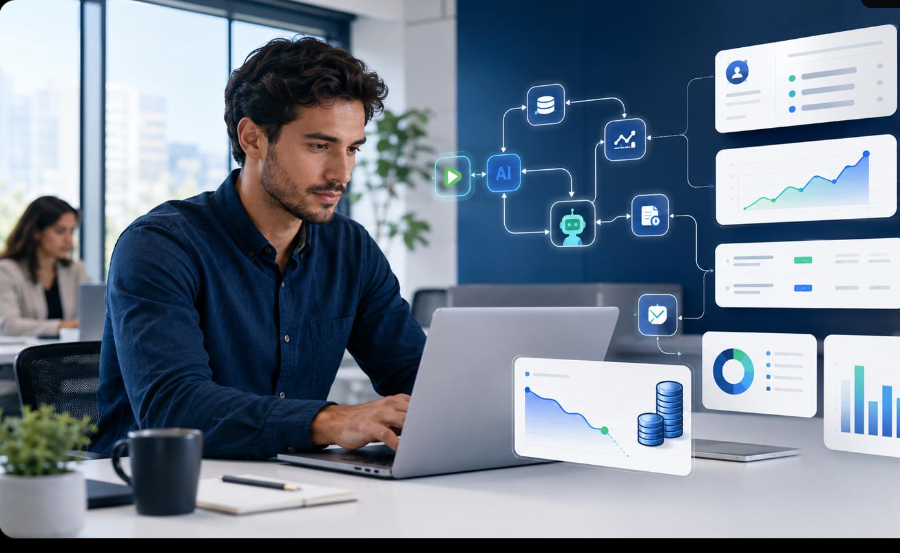
Technology is becoming one of the most important drivers of business growth, operational efficiency, and competitive advantage. From small businesses and startups to large enterprises, organizations are increasingly using digital tools to improve productivity, understand customer needs, reduce operational costs, and make better decisions.
As businesses prepare for 2027, the focus is shifting beyond simply adopting new software. Companies are exploring how artificial intelligence, automation, advanced analytics, cloud platforms, and stronger cybersecurity can solve real business problems.
The businesses that benefit most from these developments will not necessarily be those that adopt every new technology. Instead, they will be the ones that identify the right tools, implement them strategically, and prepare their employees for a more technology-driven workplace.
Here are the major technology trends businesses should watch in 2027 and how they could influence future growth.
1. Artificial Intelligence Becomes a Core Business Tool
Artificial intelligence (AI) is expected to remain one of the most influential technology trends in 2027. Businesses are moving beyond experimenting with AI chatbots and content-generation tools toward integrating AI into everyday operations.
Companies can use AI to analyze customer behavior, generate reports, assist employees, improve marketing campaigns, and support business decisions. For example, a retail business can use AI to identify purchasing patterns, while a service company can use AI assistants to respond to common customer queries.
The next phase will focus on connecting AI with business workflows and measuring its actual value. Recent industry analysis also emphasizes moving AI projects from pilot stages into practical, governed business applications.
How businesses can prepare:
-
Identify repetitive tasks that AI could simplify.
-
Start with one or two measurable business use cases.
-
Review AI-generated outputs before using them for important decisions.
-
Establish policies for customer data, accuracy, and responsible AI use.
2. AI Agents and Intelligent Automation
Traditional automation follows predefined rules, such as sending an email when a customer fills out a form. AI agents can go further by interpreting information, planning steps, and carrying out certain tasks with limited human intervention.
In 2027, businesses will increasingly explore AI agents for customer support, lead qualification, internal research, sales assistance, and workflow coordination.
For example, an AI-powered sales assistant could organize incoming leads, summarize previous customer interactions, prepare follow-up messages, and recommend which prospects a sales representative should contact first.
However, autonomous systems require clear permissions and monitoring. Businesses should not assume that an AI agent can safely make every decision independently.
How businesses can prepare:
-
Automate low-risk, repetitive workflows first.
-
Define which actions require human approval.
-
Limit access to sensitive systems and information.
-
Track time saved, error rates, and business outcomes.
3. Cybersecurity Becomes a Business Priority
As companies rely more heavily on cloud platforms, AI tools, digital payments, and connected applications, cybersecurity will become increasingly important.
Cybersecurity threats are also evolving. Businesses must consider phishing, ransomware, identity theft, third-party software vulnerabilities, and attacks that target AI systems.
A report from Gartner forecasts that spending on AI security will reach approximately $4.8 billion in 2027, reflecting the growing focus on protecting AI applications, controlling AI usage, and strengthening governance.
Cybersecurity is no longer just an IT department responsibility. A security incident can interrupt operations, damage customer trust, expose confidential information, and create financial losses.
How businesses can prepare:
-
Enable multi-factor authentication.
-
Regularly update software and operating systems.
-
Maintain secure backups of important data.
-
Train employees to identify phishing attempts.
-
Review third-party applications and AI tools before adopting them.
4. Cloud Computing and Hybrid Infrastructure
Cloud computing will continue to support business modernization in 2027. It allows organizations to access computing resources, applications, storage, and data services without managing every part of the underlying infrastructure themselves.
Cloud platforms are also important for deploying AI applications, supporting remote teams, and connecting business systems.
Small businesses can use cloud-based accounting, CRM, project management, and customer support software to reduce the need for extensive in-house infrastructure. Larger companies may combine public cloud services with private infrastructure to meet performance, security, or regulatory requirements.
However, moving everything to the cloud is not automatically the best choice. Businesses need to consider subscription costs, data protection, service reliability, and the difficulty of switching providers.
How businesses can prepare:
-
Review current IT infrastructure and operating costs.
-
Select cloud services based on business requirements.
-
Establish backup and recovery procedures.
-
Monitor cloud usage to avoid unnecessary spending.
5. Data Analytics and Real-Time Decision-Making
Businesses generate large amounts of data through websites, sales transactions, customer interactions, marketing campaigns, and operational systems. In 2027, the ability to turn this information into useful insights will remain a significant competitive advantage.
Modern analytics tools help businesses identify trends, monitor performance, forecast demand, and understand customer preferences.
For example, a company can analyze CRM data to identify customers who are likely to make repeat purchases. A marketing team can compare campaign performance to determine which channels generate qualified leads rather than simply increasing website traffic.
The objective is not to collect more data without a purpose. It is to make better decisions using reliable, relevant information.
How businesses can prepare:
-
Identify key performance indicators for each department.
-
Maintain accurate and consistent business data.
-
Build dashboards for sales, marketing, and operations.
-
Use analytics to guide decisions rather than relying entirely on assumptions.
6. AI-Powered Customer Experience and Personalization
Customer expectations continue to evolve. People increasingly expect fast responses, relevant recommendations, convenient digital experiences, and consistent support across communication channels.
AI-powered customer experience tools can help businesses meet these expectations through intelligent chatbots, personalized recommendations, automated service requests, and customer sentiment analysis.
For example, an online store could recommend products based on previous purchases, while a service business could use customer history to help support representatives provide more relevant answers.
CRM systems will play an important role by bringing customer information together and helping businesses coordinate interactions across sales, marketing, and customer service.
How businesses can prepare:
-
Integrate customer data across relevant platforms.
-
Use chatbots for routine queries while offering human support when needed.
-
Personalize communication without becoming intrusive.
-
Measure customer satisfaction, retention, and response times.
7. Low-Code and No-Code Development
Low-code and no-code platforms allow businesses to create applications, automate workflows, and build internal tools with limited traditional programming.
These platforms can be useful for small businesses that need customized solutions but lack large development teams.
For instance, a company could create an internal approval system, build a dashboard for sales leads, or automate employee onboarding using visual development tools.
AI-assisted development is also making it easier for employees to generate prototypes and simple applications. However, faster development introduces new questions about application security, access permissions, maintenance, and data governance. Gartner identifies the management of AI-generated and short-lived applications as an emerging organizational challenge.
How businesses can prepare:
-
Identify simple processes that could benefit from custom tools.
-
Establish guidelines for approved platforms.
-
Restrict access to confidential business information.
-
Test applications before using them for critical operations.
8. Internet of Things and Smart Operations
The Internet of Things (IoT) connects physical devices, machines, sensors, and equipment to digital systems so that they can collect and exchange information.
IoT technology can help businesses monitor equipment performance, track inventory, manage energy consumption, and improve supply chain visibility.
In manufacturing, connected sensors can identify unusual machine behavior before it leads to equipment failure. In logistics, tracking devices can provide information about the location and condition of goods.
As IoT systems become more closely integrated with analytics and AI, businesses can use operational data to improve efficiency and respond to problems faster.
How businesses can prepare:
-
Identify operations where real-time monitoring would be useful.
-
Start with a limited pilot project.
-
Protect connected devices with strong security controls.
-
Evaluate the financial benefits before expanding deployment.
9. Digital Twins and Predictive Maintenance
A digital twin is a virtual representation of a physical asset, system, or process that can be updated using real-world data.
Businesses can use digital twins to monitor performance, test possible changes, and understand how equipment or systems may behave under different conditions.
For example, a manufacturing company could create a digital model of a production line to examine bottlenecks before changing its physical layout. A building operator could use connected sensors and a digital model to monitor energy consumption.
This technology is especially relevant to manufacturing, infrastructure, logistics, and complex industrial operations. Its value depends on having reliable data, suitable software, and a clear operational objective.
How businesses can prepare:
-
Begin with high-value assets or processes.
-
Ensure the data feeding the model is accurate.
-
Identify the decisions the digital twin should support.
-
Compare implementation costs with measurable operational benefits.
10. Sustainable Technology and Energy Efficiency
Sustainability is becoming an important consideration in technology planning. Businesses are looking for ways to manage energy consumption, reduce waste, improve resource efficiency, and understand the environmental impact of their digital infrastructure.
AI systems and data centres also require computing resources and electricity, making energy efficiency an important part of technology investment decisions.
Businesses can explore energy monitoring software, efficient cloud infrastructure, smart building systems, and equipment designed to reduce unnecessary resource consumption.
Sustainable technology can support both environmental objectives and cost management, although the benefits will vary depending on the business and the solution adopted.
How businesses can prepare:
-
Monitor electricity and resource consumption.
-
Evaluate the energy efficiency of IT infrastructure.
-
Consider equipment lifespan and electronic waste.
-
Include sustainability measures in technology procurement decisions.
11. Edge Computing and Faster Data Processing
Edge computing processes data closer to where it is generated instead of sending everything to a distant cloud server.
This approach can be useful when businesses need quick responses, local processing, or reduced dependence on continuous internet connectivity.
For example, a factory may need to detect a machine fault immediately. A connected retail system may need to process information locally to keep essential functions running during a network disruption.
Edge computing can complement cloud computing rather than replace it. Businesses can process time-sensitive information locally while using cloud platforms for broader analytics and long-term storage.
How businesses can prepare:
-
Identify operations that require rapid responses.
-
Assess network reliability and data processing needs.
-
Consider the security of devices deployed outside centralized IT environments.
-
Determine which workloads belong at the edge and which belong in the cloud.
12. Physical AI and Business Robotics
AI is increasingly being integrated into physical systems, including robots, drones, autonomous equipment, and smart industrial machines. This development is often described as physical AI.
In business environments, these technologies can assist with warehouse operations, repetitive manufacturing tasks, inventory inspection, and certain hazardous activities.
Industry outlooks for 2027 identify physical AI as one of the forces that could reshape technology competition as intelligence moves beyond software and into physical environments.
Adoption will depend on the cost of equipment, workplace safety, integration requirements, and the complexity of the task.
How businesses can prepare:
-
Identify repetitive or hazardous tasks that could benefit from robotics.
-
Evaluate safety and regulatory requirements.
-
Train employees to work alongside automated systems.
-
Begin with a controlled pilot before scaling.
How Businesses Can Prepare for Technology Changes in 2027
Understanding technology trends is only the first step. Businesses need a practical plan to decide which innovations deserve investment and how to implement them successfully.
1. Identify business problems first
Choose technology based on a specific need, such as reducing manual work, improving customer retention, or increasing operational efficiency.
2. Set a realistic budget and measure ROI
Include subscription fees, integration, employee training, maintenance, and security costs when evaluating a solution.
3. Prepare employees for change
Provide training and explain how new tools will support employees' work rather than introducing technology without a clear adoption plan.
4. Make security and governance part of implementation
Establish rules for data access, AI usage, privacy, application approvals, and human oversight.
5. Start small and scale what works
Run a pilot project, evaluate the results against predefined goals, and expand only when the benefits justify the additional investment.
Which Technology Trends Should Small Businesses Prioritize?
Not every business needs robotics, digital twins, or advanced edge computing. The right priorities depend on company size, industry, budget, and business objectives.
|
Business priority |
Technologies to consider |
|---|---|
|
Improve productivity |
AI assistants and workflow automation |
|
Generate more leads |
AI marketing tools and CRM automation |
|
Improve customer service |
AI chatbots and integrated CRM |
|
Reduce security risks |
Multi-factor authentication and cybersecurity tools |
|
Improve business decisions |
Data analytics and dashboards |
|
Reduce IT infrastructure complexity |
Cloud computing and SaaS tools |
|
Streamline internal processes |
Low-code and no-code platforms |
For many small businesses, starting with AI-assisted workflows, reliable cloud software, CRM improvements, and stronger cybersecurity will be more practical than investing in expensive emerging technologies immediately.
Conclusion
The technology trends businesses should watch in 2027 point toward a more connected, automated, data-driven, and intelligent business environment.
Artificial intelligence, AI agents, cybersecurity, cloud computing, data analytics, and personalized customer experiences are likely to remain important areas of attention. At the same time, technologies such as IoT, digital twins, edge computing, and physical AI may create new opportunities for businesses with specialized operational needs.
However, adopting technology simply because it is popular does not guarantee success. Companies should evaluate each solution based on its practical benefits, implementation costs, security implications, and ability to support long-term objectives.
The key to business success in 2027 will be using technology strategically: solving real problems, empowering employees, protecting customer data, and turning innovation into measurable results.
Frequently Asked Questions (FAQs)
1. What are the top technology trends for businesses in 2027?
Major trends include artificial intelligence, AI agents, intelligent automation, cybersecurity, cloud computing, data analytics, low-code development, IoT, digital twins, and physical AI.
2. How will AI help businesses in 2027?
AI can help businesses automate repetitive work, analyze data, assist customer support, personalize marketing, and improve decision-making. Its impact will depend on implementation quality, reliable data, and appropriate human oversight.
3. Which technology trends are most useful for small businesses?
AI assistants, CRM automation, cloud-based software, data analytics, cybersecurity tools, and low-code platforms can be practical starting points for small businesses.
4. Why is cybersecurity important in 2027?
Businesses are becoming more dependent on digital systems and AI tools. Strong cybersecurity helps protect confidential information, maintain operations, reduce fraud risks, and preserve customer trust.
5. How can businesses prepare for emerging technologies?
Businesses can prepare by identifying their priorities, setting technology budgets, training employees, reviewing security requirements, testing new solutions, and measuring results before scaling.