AI Agents: How Autonomous AI Is Transforming Business in 2026
Artificial intelligence is moving beyond simple chatbots and content-generation tools. One of the most significant developments in technology today is the rise of AI agents—systems designed to understand goals, make decisions, use digital tools, and complete tasks with limited human intervention.
Unlike traditional AI applications that generally respond to individual commands, AI agents can potentially handle a sequence of actions to achieve a specific objective. This makes them particularly valuable for businesses looking to automate workflows, improve productivity, and deliver better customer experiences.
As organizations continue adopting artificial intelligence, AI agents are emerging as an important part of the next generation of business automation.
What Are AI Agents?
AI agents are software systems that use artificial intelligence to perform tasks based on a defined goal.
A conventional software application usually follows predefined instructions. An AI agent, by contrast, can use AI models to interpret information, determine what needs to be done, select appropriate tools, and take actions within the permissions given to it.
For example, an AI agent used by a business could potentially:
Analyze incoming customer queries
Retrieve information from a knowledge base
Draft an appropriate response
Update customer records
Schedule follow-up activities
Generate reports
Escalate complex cases to human employees
The level of autonomy depends on how the system is designed and what access it receives.
Why Are AI Agents Becoming Important?
Businesses generate enormous amounts of data and perform thousands of repetitive digital tasks every day. Employees often spend considerable time searching for information, preparing reports, responding to routine requests, and moving information between systems.
AI agents can help automate portions of these workflows.
1. Increased Productivity
AI agents can assist employees with repetitive and time-consuming activities, allowing teams to focus more on creative, strategic, and customer-focused work.
For example, an AI agent could collect information from different sources and prepare a preliminary business report for an employee to review.
2. Customer Service Automation
AI agents can support customer-service operations by handling common questions, retrieving relevant information, and directing complicated cases to human representatives.
This can help organizations provide faster responses while allowing customer-service teams to concentrate on issues requiring human judgment.
3. Smarter Business Operations
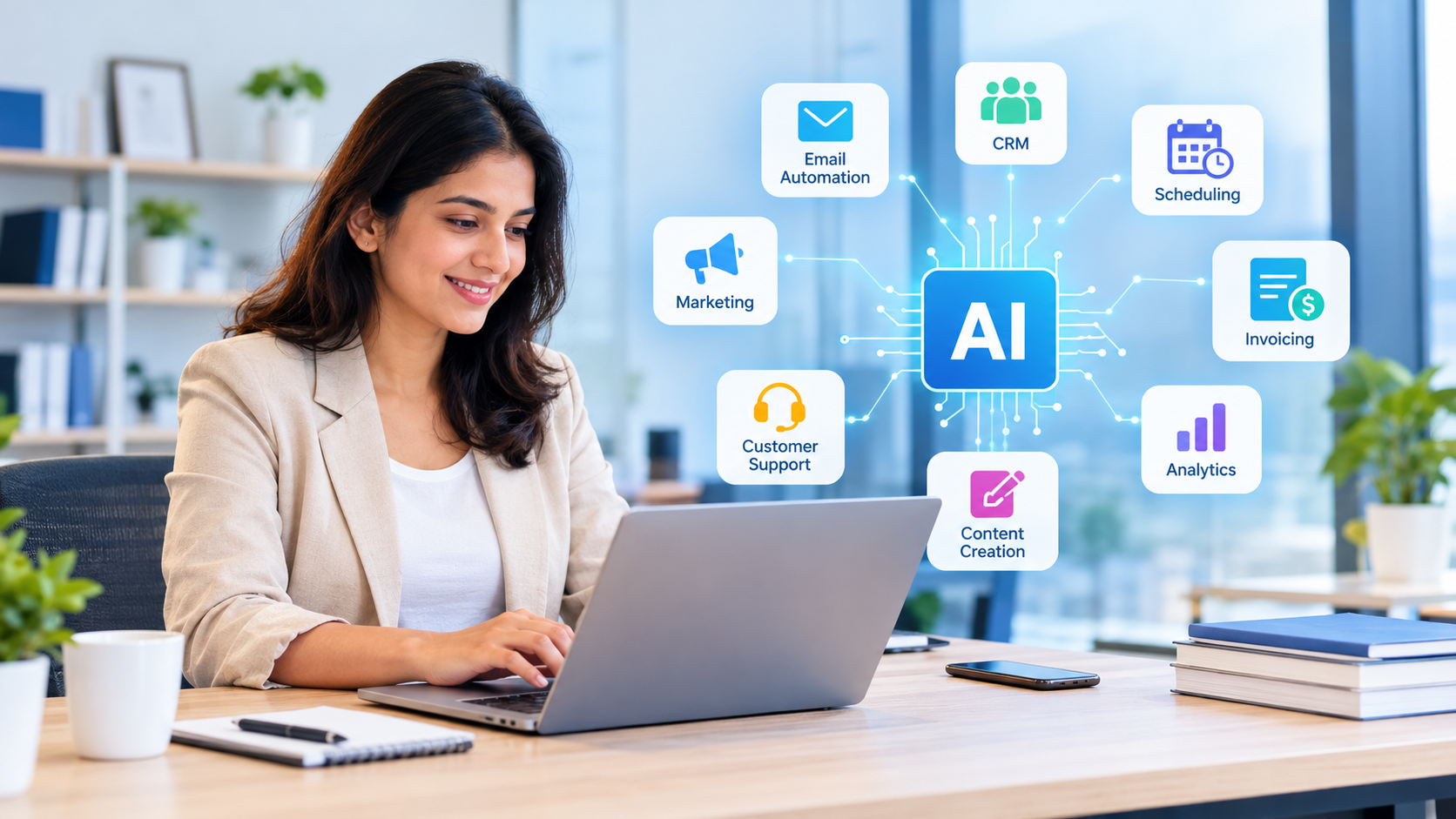
AI agents can connect different steps of a workflow. Instead of employees manually performing every step, an agent can assist with coordinating activities across business applications.
This could be useful in areas such as:
Sales
Marketing
Customer relationship management
Human resources
Finance
Operations
IT support
4. Personalized Customer Experiences
AI can analyze customer information and interactions to help businesses provide more personalized experiences.
For example, AI-powered systems can help identify customer preferences, previous interactions, and potential needs, enabling businesses to create more relevant communication.
AI Agents vs Traditional Chatbots
AI agents and traditional chatbots are not exactly the same.
| Feature | Traditional Chatbot | AI Agent |
|---|---|---|
| Primary purpose | Answer questions | Complete goals and tasks |
| Decision-making | Limited | More adaptive |
| Workflow execution | Usually limited | Can perform multiple steps |
| Tool usage | Often restricted | Can potentially use multiple tools |
| Autonomy | Low | Higher, depending on design |
| Business applications | Customer support | Automation across multiple workflows |
The distinction is important because AI agents are increasingly being designed to take action, rather than simply generate text.
How AI Agents Can Be Used in Business
AI agents can potentially support several departments.
Marketing
Marketing teams can use AI-powered systems to assist with:
Content research
Campaign analysis
Audience segmentation
Social-media planning
Competitor monitoring
Performance reporting
Sales
Sales teams can use AI agents to help with:
Lead qualification
Customer research
Follow-up reminders
CRM updates
Sales reporting
Proposal preparation
Human Resources
Potential HR applications include:
Candidate screening assistance
Interview scheduling
Employee queries
Onboarding workflows
HR document organization
Finance
AI systems can assist with:
Financial data analysis
Expense categorization
Report preparation
Anomaly detection
Routine financial workflows
However, financial decisions involving significant risk should continue to involve appropriate human oversight.
Benefits of AI Agents
The adoption of AI agents can provide several potential advantages.
Automation: Repetitive processes can be partially or fully automated.
Speed: AI systems can process large amounts of information quickly.
Scalability: Automated workflows can potentially handle increasing workloads without requiring proportional increases in manual effort.
Consistency: Automated processes can reduce certain types of human errors.
Employee Productivity: Employees can spend more time on higher-value activities.
Data-Driven Decisions: AI can help organizations analyze large datasets and identify patterns.
Challenges and Risks
Despite their potential, AI agents also introduce important challenges.
Data Privacy
AI systems may interact with sensitive business and customer information. Organizations must establish appropriate data-protection practices and access controls.
Security
Giving an AI system access to business applications can introduce security risks if permissions are poorly designed.
Accuracy
AI systems can produce incorrect information or make inappropriate decisions. Important outputs should therefore be reviewed according to the risk involved.
Human Oversight
Greater autonomy does not eliminate the need for humans. Businesses need clear rules defining which actions AI can perform independently and which require human approval.
Implementation Costs
Developing and integrating AI agents into existing systems may require investment in technology, infrastructure, security, training, and skilled professionals.
The Future of AI Agents
The future of AI agents is likely to involve deeper integration with business software and digital workflows.
Instead of using separate AI tools for individual tasks, organizations may increasingly build AI-powered workflows that connect CRM systems, communication platforms, analytics tools, productivity software, and internal databases.
This could lead to a shift from "AI that answers" to "AI that assists with getting work done."
However, successful adoption will depend not only on technological capabilities but also on responsible implementation, cybersecurity, governance, employee training, and human oversight.
How Businesses Can Prepare for the AI Agent Era
Companies interested in adopting AI agents should begin with practical and low-risk use cases.
A useful approach is:
Step 1: Identify repetitive tasks
Find processes that consume significant employee time.
Step 2: Evaluate the workflow
Determine which activities can safely be assisted or automated.
Step 3: Start with a controlled pilot
Test AI on a limited workflow before deploying it across the organization.
Step 4: Establish permissions
Give AI systems only the access they actually require.
Step 5: Monitor performance
Track accuracy, efficiency, cost, and potential risks.
Step 6: Keep humans involved
Create clear escalation procedures for sensitive or high-impact decisions.
Conclusion
AI agents represent an important evolution in artificial intelligence and business automation. Their ability to understand objectives, work through multiple steps, interact with digital tools, and assist with workflows could significantly change how organizations operate.
For businesses, the opportunity is not simply to replace manual work. The larger opportunity is to create faster, smarter, and more efficient ways of working while allowing employees to focus on activities where human creativity, judgment, and relationships remain essential.
As AI technology continues to develop, organizations that experiment responsibly with AI agents today may be better prepared for the increasingly AI-driven business environment of tomorrow.