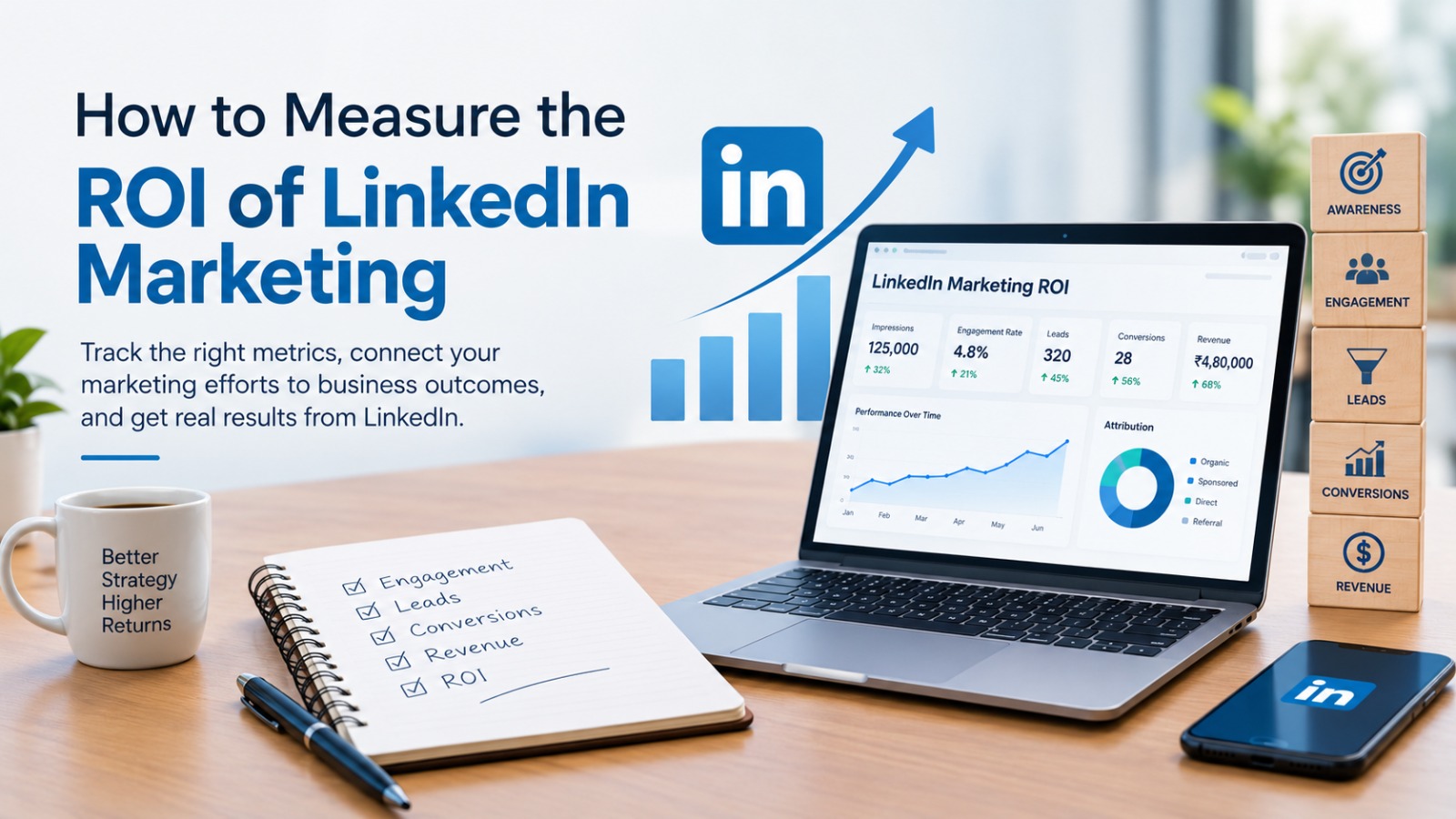
How to Measure the ROI of LinkedIn Marketing is an important question for businesses investing time, money, and resources into LinkedIn. While likes, comments, impressions, and followers can indicate engagement, they do not always show whether your LinkedIn marketing is contributing to business growth.
A successful LinkedIn strategy should ultimately connect marketing activities with measurable business outcomes such as qualified leads, sales opportunities, website conversions, customer acquisition, and revenue.
In this guide, we explain how businesses can measure LinkedIn marketing ROI, which metrics matter most, and how to build a practical measurement framework.
What Is LinkedIn Marketing ROI?
LinkedIn marketing ROI measures the business value generated from LinkedIn marketing compared with the investment made in those activities.
A basic ROI formula is:
LinkedIn Marketing ROI = (Revenue Generated − Marketing Investment) ÷ Marketing Investment × 100
For example, if a business spends ₹50,000 on LinkedIn marketing and generates ₹1,50,000 in attributable revenue:
ROI = (₹1,50,000 − ₹50,000) ÷ ₹50,000 × 100 = 200%
However, measuring LinkedIn ROI is not always as simple as looking at direct sales. LinkedIn can influence customers at different stages of the buying journey, so businesses should track both direct and supporting metrics.
Why Measuring LinkedIn Marketing ROI Matters
LinkedIn marketing can involve several activities, including organic content, personal branding, paid advertising, employee advocacy, networking, lead generation, and social selling.
Without proper measurement, businesses may continue investing in activities simply because they generate engagement.
ROI measurement helps businesses understand:
-
Which LinkedIn activities generate qualified leads
-
Which content contributes to conversions
-
How much it costs to acquire a customer
-
Which campaigns generate revenue
-
Which audiences respond best
-
Whether paid LinkedIn campaigns are profitable
-
Which content formats deserve more investment
-
Where the marketing funnel needs improvement
The goal is not simply to achieve more impressions. The goal is to understand how LinkedIn contributes to measurable business results.
Step 1: Define Your LinkedIn Marketing Goals
Before measuring ROI, establish what you want LinkedIn marketing to accomplish.
Different businesses can have different objectives.
For example:
B2B company: Generate qualified leads and sales opportunities.
Consultant: Build authority and generate discovery calls.
SaaS company: Generate product demos and free-trial registrations.
Recruitment company: Generate employer and candidate leads.
Professional service business: Build relationships with decision-makers.
Your ROI framework should therefore begin with specific objectives.
Instead of saying:
"We want more engagement."
Set a measurable goal such as:
"Generate 50 qualified leads from LinkedIn within three months."
Clear goals make it easier to determine whether your marketing investment is producing meaningful results.
Step 2: Track the Right LinkedIn Marketing Metrics
Not every LinkedIn metric has the same business value.
A useful measurement system can be divided into four categories: awareness, engagement, lead generation, and revenue.
1. Awareness Metrics
Awareness metrics help you understand how many people are being exposed to your brand.
Important metrics include:
-
Impressions
-
Reach
-
Profile views
-
Follower growth
-
Company page visits
-
Video views
These metrics are useful for understanding visibility, but they should not be treated as direct evidence of revenue.
A post receiving 100,000 impressions may generate less business value than a post receiving 5,000 impressions if the smaller post reaches the right decision-makers.
2. Engagement Metrics
Engagement shows how people interact with your content.
Track:
-
Likes
-
Comments
-
Shares
-
Saves
-
Clicks
-
Engagement rate
-
Link click-through rate
Engagement can help identify content that resonates with your target audience.
However, high engagement does not automatically mean high ROI.
A business should examine whether engagement leads to meaningful actions such as website visits, inquiries, registrations, or sales conversations.
3. Lead Generation Metrics
For many B2B companies, lead generation is one of the most important LinkedIn marketing objectives.
Track:
-
Leads generated
-
Qualified leads
-
Lead conversion rate
-
Cost per lead
-
Demo requests
-
Consultation bookings
-
Contact-form submissions
-
Lead-to-opportunity rate
For example, if LinkedIn generates 100 leads but only two are qualified, the campaign may require optimization even though the lead volume looks impressive.
4. Revenue Metrics
Revenue metrics connect LinkedIn marketing with actual business results.
Track:
-
Sales opportunities generated
-
Customers acquired
-
Revenue attributed to LinkedIn
-
Customer acquisition cost
-
Pipeline value
-
Return on ad spend
-
Marketing ROI
These metrics help move your analysis beyond vanity metrics and toward business outcomes.
Step 3: Calculate Cost Per Lead
Cost per lead is particularly useful for LinkedIn campaigns focused on lead generation.
The formula is:
Cost Per Lead = Total LinkedIn Marketing Cost ÷ Number of Leads Generated
For example, suppose a company spends ₹40,000 on LinkedIn advertising and generates 80 leads.
CPL = ₹40,000 ÷ 80 = ₹500
However, businesses should also calculate the cost per qualified lead.
If only 20 of those 80 leads are qualified:
Cost Per Qualified Lead = ₹40,000 ÷ 20 = ₹2,000
This provides a more useful picture of lead quality.
Step 4: Measure Lead-to-Customer Conversion
Generating leads is only one part of the marketing funnel.
You also need to understand how many leads eventually become customers.
For example:
1,000 LinkedIn visitors → 100 leads → 20 qualified leads → 5 customers
This funnel reveals where opportunities and problems exist.
If LinkedIn generates many visitors but very few leads, your landing page or offer may need improvement.
If you generate many leads but very few customers, the issue may involve lead quality, sales follow-up, pricing, positioning, or the sales process.
Step 5: Track Customer Acquisition Cost
Customer Acquisition Cost, or CAC, estimates how much your business spends to acquire a customer.
A simplified formula is:
CAC = Total Marketing and Sales Cost ÷ Number of New Customers
For LinkedIn-focused campaigns, businesses can calculate LinkedIn-specific acquisition costs where attribution is reliable.
For example, if LinkedIn-related marketing and sales activity costs ₹1,00,000 and results in 10 customers:
CAC = ₹1,00,000 ÷ 10 = ₹10,000 per customer
You can then compare this cost with the customer's revenue or lifetime value.
Step 6: Measure LinkedIn Conversion Rates
Conversion rate helps determine how effectively LinkedIn traffic or leads move toward a desired action.
The formula is:
Conversion Rate = Number of Conversions ÷ Number of Visitors or Leads × 100
For example, if 2,000 people visit your website from LinkedIn and 100 submit an inquiry:
Conversion Rate = 100 ÷ 2,000 × 100 = 5%
Tracking conversion rates helps identify whether your LinkedIn content is attracting the right audience and whether your website experience supports conversion.
Step 7: Use UTM Parameters to Track Website Traffic
One of the easiest ways to improve LinkedIn ROI measurement is to use UTM parameters on links shared through LinkedIn.
UTM parameters allow analytics platforms to identify where website visitors came from.
You can track information such as:
-
Source
-
Medium
-
Campaign
-
Content
-
Search terms where applicable
For example, different LinkedIn campaigns can use different campaign identifiers so you can compare their website traffic and conversions.
This becomes particularly useful when a business publishes multiple content campaigns or runs several paid advertisements.
Step 8: Measure Content-Level Performance
Instead of evaluating your entire LinkedIn account as one channel, analyze individual pieces of content.
For each important post, track:
Post → Clicks → Website visits → Leads → Qualified leads → Opportunities → Customers
This can reveal which topics attract your ideal audience.
For example, a business may discover that educational posts generate awareness while case studies generate more inquiries.
This information can then influence the future content strategy.
Step 9: Measure LinkedIn Ads Separately
If you are using LinkedIn Ads, separate paid performance from organic LinkedIn activity.
Important paid advertising metrics include:
-
Ad impressions
-
Click-through rate
-
Cost per click
-
Cost per lead
-
Leads
-
Qualified leads
-
Conversion rate
-
Pipeline generated
-
Revenue attributed to campaigns
A campaign with a low cost per click is not necessarily successful if the resulting traffic does not convert.
Similarly, a campaign with a higher cost per lead may still create more business value if its leads have a higher conversion rate and customer value.
Step 10: Measure the Value of Organic LinkedIn Marketing
Organic LinkedIn marketing can be more difficult to measure because its impact may happen over a longer period.
Someone may see a post today, follow the company next month, visit the website later, and eventually contact the business.
Therefore, businesses should monitor indicators such as:
-
Profile visits
-
Website traffic
-
Direct inquiries
-
Content engagement
-
Follower growth
-
Inbound messages
-
Lead generation
-
Assisted conversions
-
Sales conversations
For personal brands, founder-led marketing, and thought leadership, it is also useful to track business conversations that originate after content exposure.
LinkedIn Marketing ROI vs ROAS
ROI and ROAS are related but different.
ROAS — Return on Ad Spend focuses specifically on advertising revenue compared with advertising spend.
ROI — Return on Investment considers the broader investment and return.
For example:
ROAS = Revenue from Ads ÷ Advertising Spend
ROI can incorporate broader expenses such as content creation, management, tools, advertising, and other marketing costs.
Businesses should choose the measurement that matches their marketing objective.
Common Mistakes When Measuring LinkedIn ROI
Focusing Only on Likes
Likes are easy to see, but they do not necessarily indicate revenue.
Measuring Followers Instead of Business Outcomes
Follower growth can be useful, but the quality and relevance of those followers matter more than the number alone.
Ignoring Lead Quality
A large number of low-quality leads can consume more sales resources than a smaller number of qualified prospects.
Not Tracking the Entire Funnel
Stopping measurement at clicks or leads makes it difficult to understand the actual business impact.
Mixing Organic and Paid Results
Organic content and paid campaigns often have different objectives and costs. Separating them can provide clearer insights.
Failing to Track Offline Conversions
Some LinkedIn leads may eventually become customers through phone calls, meetings, emails, or offline sales processes. Connecting these outcomes back to their original source can improve attribution.
Create a LinkedIn ROI Dashboard
Businesses can create a simple monthly LinkedIn marketing dashboard containing:
| Metric | Monthly Result |
|---|---|
| Impressions | Track monthly |
| Engagement Rate | Track % |
| Website Visits | Track volume |
| Leads | Track number |
| Qualified Leads | Track number |
| Cost Per Lead | Calculate |
| Sales Opportunities | Track number |
| Customers | Track number |
| Revenue | Track amount |
| Marketing Cost | Track amount |
| ROI | Calculate |
Reviewing these metrics every month can help identify trends and improve future campaigns.
How to Improve LinkedIn Marketing ROI
Once you know your numbers, use them to optimize your strategy.
Improve Audience Targeting
Focus your content and campaigns on the people who are most relevant to your business.
Create Content Around Customer Problems
Educational content addressing real customer challenges can attract more relevant prospects.
Improve Your Offer
A strong LinkedIn post may generate clicks, but the offer or landing page must give visitors a clear reason to take the next step.
Test Different Content Formats
Experiment with text posts, carousels, videos, case studies, industry insights, and educational content.
Strengthen Your Follow-Up Process
Marketing performance can be affected by what happens after a lead is generated. Fast and relevant follow-up can help move qualified prospects through the sales process.
Analyze Results Regularly
LinkedIn marketing should be treated as an ongoing process rather than a one-time campaign. Review performance, identify patterns, test improvements, and measure again.
Final Thoughts
How to Measure the ROI of LinkedIn Marketing is ultimately about connecting LinkedIn activity with business outcomes.
Impressions, followers, likes, and comments can help you understand visibility and engagement, but they should be combined with deeper metrics such as qualified leads, conversion rates, customer acquisition cost, sales opportunities, and revenue.
A practical LinkedIn ROI framework should follow the complete journey:
Content → Engagement → Website Visit → Lead → Qualified Lead → Sales Opportunity → Customer → Revenue
When businesses track this journey consistently, LinkedIn becomes easier to evaluate, optimize, and integrate into a broader marketing strategy.
The objective is not simply to generate more activity on LinkedIn. It is to understand which activities contribute to meaningful business results and use those insights to make future marketing decisions.